

Direct answer
Uber AI customer service cuts support cost control map: what CRM buyers should take from it
Business Insider reported in July 2026 that Uber is cutting about 10% of its community operations customer-service team and tying the change to AI, simpler operations, and more in-person collaboration. CX Dive and Engadget separately covered the move. Support buyers should not treat the headline as proof that AI automatically lowers service cost. They should require an AI Support Staffing Cost-Control Map showing which tasks disappear, which human work remains, how queues and SLAs change, whether remote coverage is affected, and whether escalations, complaints, credits, and rework offset the savings.
Published 7/24/2026. News event: 7/23/2026.
What happened
- Business Insider reported that Uber is cutting about 10% of its community operations customer-service team.
- The report said Uber cited AI, operational simplification, and stronger in-person collaboration, and also required some remote employees to relocate near offices.
- CX Dive separately reported that Uber is cutting 10% of its customer-service workforce to simplify operations and embrace AI, citing Bloomberg as first reporting the move.
- Engadget also covered the layoff and said the affected division is Uber's global customer-support network across businesses and languages.
- The buyer-relevant issue is not whether Uber should make that staffing decision. It is whether any support team can prove AI savings after retained work, queue friction, customer risk, and recovery cost are included.
Why this is trending
- The story connects AI, customer service, workforce reduction, and return-to-office pressure in one high-profile support operation.
- Support leaders are under pressure to show AI savings, but customer-service work often reappears as escalations, reopens, complaints, credits, and manual recovery.
- Because Uber's community operations support multiple services and languages, the story makes coverage, queue design, and exception handling visible as buyer diligence issues.
- Independent coverage across Business Insider, CX Dive, and Engadget shows the story has momentum beyond a single company memo.
The CRM Costs take
A CRM or support buyer should use the Uber story as a cost-control diligence prompt, not as a layoff template. The buyer needs an AI Support Staffing Cost-Control Map: task inventory, automation coverage, retained-human work, queue and SLA risk, remote-coverage impact, escalation and complaint monitoring, quality checks, and a recovery-cost model that proves savings stayed in the system.
AI Support Staffing Cost-Control Map
A support-ops buyer framework for validating AI staffing economics across task removal, retained human work, queue risk, remote coverage, escalation load, quality proof, and customer recovery cost.
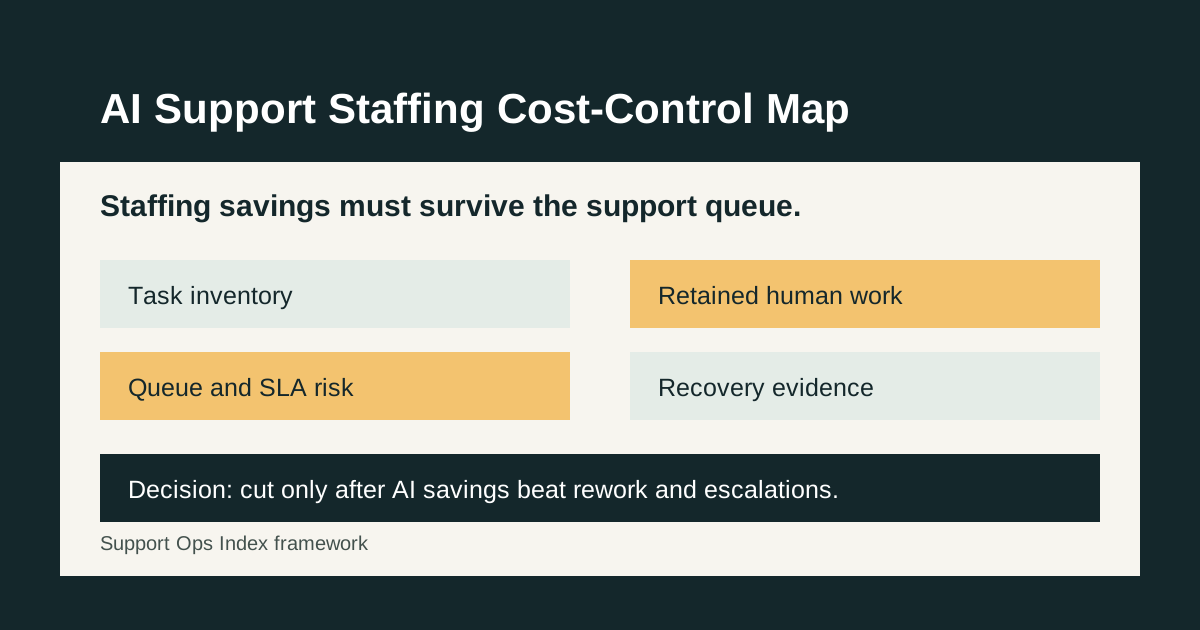
Create a task inventory with baseline volume, automation rate, exception rate, language or region coverage, and retained-review rule.
Measure retained work by case type, role, skill, queue, escalation owner, and weekly hours after automation.
Monitor queues by intent, customer segment, language, region, product, and escalation tier, not only by global average.
Compare schedule coverage, attrition risk, relocation uptake, language coverage, and surge staffing before and after the change.
Track escalation volume, reopen causes, manager review hours, correction tickets, and policy exceptions weekly.
Build a recovery-cost model with complaints, credits, retention impact, rework, refunds, and manual-contact hours.
What buyers should do next
Buyer FAQs
What did Business Insider report about Uber's customer-service cuts?
Business Insider reported that Uber is cutting about 10% of its community operations customer-service team, tying the change to AI, operational simplification, and more in-person collaboration.
Why does this matter to CRM and support buyers?
AI can reduce simple contacts, but the remaining work may be more complex. Buyers need proof that queue risk, escalation load, and recovery cost do not erase staffing savings.
What proof should buyers request first?
Ask for a task inventory, retained-human work model, queue-risk report, remote-coverage impact, escalation monitoring, and recovery-cost model before approving staffing cuts.