

Direct answer
Thomson Reuters shadow AI revenue risk: what CRM buyers should take from it
Thomson Reuters released its 2026 Future of Professionals report on June 22, 2026 and warned that up to $143 billion in U.S. professional-services revenue is under active reassessment based on AI delivery. The report also says one third of lawyers, accountants, and compliance professionals are using unsanctioned AI tools. For CRM and support operations leaders, the lesson is clear: AI governance is now an operating control, not a policy document.
Published 6/24/2026. News event: 6/22/2026.
What happened
- Thomson Reuters said its 2026 Future of Professionals report is based on a global survey of 1,800 professionals.
- The company warned that up to $143 billion in U.S. legal and accounting revenue is under active reconsideration as clients expect AI-enabled improvements.
- The report says 74% of professionals use AI weekly, but 91% believe their organizations are falling short of what AI can deliver.
- Thomson Reuters also said one third of lawyers, accountants, and compliance professionals use unsanctioned AI, creating risk their organizations cannot monitor or control.
Why this is trending
- The story turns AI from a productivity experiment into a measurable revenue, client-retention, talent, and compliance risk.
- Shadow AI is now a day-to-day operations problem: employees may paste sensitive records, ticket details, contracts, or client context into unapproved tools because official workflows are too slow.
- CRM and support operations teams are often where the risk appears first, because customer records, internal notes, case histories, and service data move through many tools.
The CRM Costs take
CRM and support buyers should not respond by banning AI with a policy nobody follows. They need a control layer: approved tools, field-level data rules, workflow owners, audit logs, prompt/output review, and a way to measure whether automation improves customer outcomes instead of creating hidden risk.
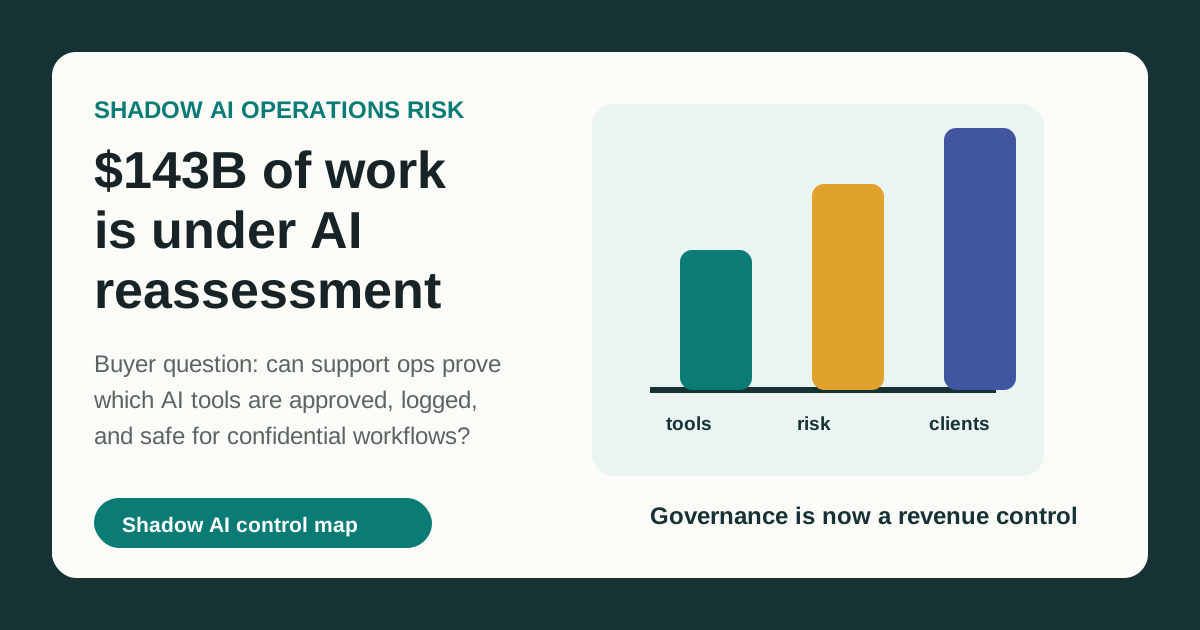
Shadow AI Control Map
A support operations framework for finding unsanctioned AI use, mapping confidential workflows, approving tools, measuring value, and preventing hidden CRM or helpdesk risk.
Create an AI tool register with owner, approved use case, data boundary, and renewal or access status.
Define no-paste fields and safe summary patterns before enabling broad AI use.
Require source links, reviewer approval, and exception flags for customer-facing or regulated outputs.
Assign workflow owners for intake, routing, resolution, escalation, QA, and correction.
Track reopened cases, correction rate, cycle time, escalation accuracy, and client-impact evidence.
What buyers should do next
Buyer FAQs
What did Thomson Reuters report?
Thomson Reuters reported that professional firms face major AI execution pressure, including up to $143 billion in U.S. revenue under active reassessment and widespread use of unsanctioned AI tools.
Why does shadow AI matter for CRM and support operations?
CRM and support workflows contain customer records, notes, transcripts, account details, contracts, billing context, and internal decisions. Unsanctioned AI use can expose that data or produce unsupported outputs.
Should teams ban AI tools to reduce risk?
A blanket ban often drives more shadow usage. A better control is to approve specific tools and workflows, define data boundaries, log use, assign owners, and verify outputs before they reach customers.
What should an operations leader check first?
Start with an AI tool inventory, then map which customer data can enter each tool, who approves output, and how the team measures whether AI improves service quality.