

Direct answer
ServiceNow global restructuring AI ops cost control CRM support workflow proof map: what CRM buyers should take from it
Business Insider reported in July 2026 that ServiceNow cut several hundred jobs in a global restructuring, while ServiceNow's official Q2 release showed strong AI and subscription momentum. Support-ops buyers should not treat that combination as a simple layoffs story or a platform endorsement. It is a cost-control signal: before counting AI workflow savings, buyers need an AI Ops Cost-Control Map covering licenses, admin capacity, data cleanup, governance, automation quality, and recovery cost.
Published 7/29/2026. News event: 7/28/2026.
What happened
- Business Insider reported that ServiceNow cut several hundred jobs in a global restructuring intended to improve operational efficiency.
- The Business Insider report described the cuts as a low-single-digit share of a workforce that stood at 29,187 employees at the end of 2025.
- Salesforce Ben reported ServiceNow confirmed additional staff cuts were global in nature and said the company was investing in AI-focused skills while managing headcount discipline.
- Salesforce Ben's earlier June coverage reported a three-figure number of ServiceNow cuts and cited the company's statement that it was seeing real AI efficiencies inside its own business.
- ServiceNow's official Q2 2026 release reported $3.877 billion in subscription revenue and said net-new AI annual contract value had crossed $1 billion.
- ServiceNow also said AI deployments increased ninefold over nine months and highlighted AI Control Tower expansion, Autonomous Workforce specialists, and Action Fabric.
Why this is trending
- The story combines two buyer signals that usually appear separately: enterprise software AI growth and headcount discipline inside the platform company itself.
- CRM, ITSM, helpdesk, RevOps, and support leaders are under pressure to show AI savings, but the operating cost often shifts into admin work, data cleanup, workflow redesign, QA, and exception handling.
- ServiceNow sits inside mission-critical workflows, so platform AI changes affect ticket routing, approvals, knowledge, audit trails, escalation, and service reporting.
- Independent coverage of layoffs and official financial AI momentum make the story useful as buyer-risk news rather than a vendor product announcement.
The CRM Costs take
A support-ops buyer should not approve an AI workflow plan because a vendor says automation will reduce labor. The buyer needs a cost-control map that starts with the current license and labor baseline, then proves which tasks AI removes, which admin work remains, which data must be cleaned, who governs changes, how quality is evaluated, and what recovery work appears when automation is wrong.
AI Ops Cost-Control Map
A CRM and support-ops buyer framework for validating AI workflow savings across license baseline, admin capacity, data cleanup, governance, automation quality, and customer recovery cost.
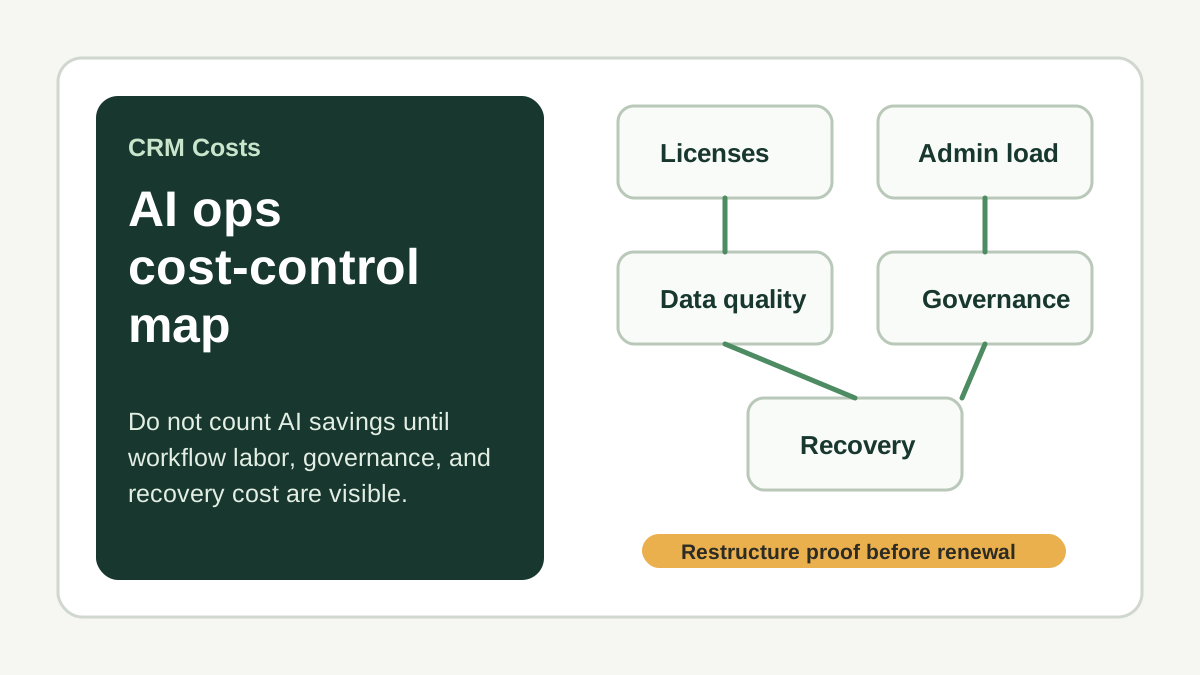
Build a before-and-after license ledger with seat counts, AI usage assumptions, renewal dates, module dependencies, and owner.
Name workflow owners and estimate weekly admin hours for change review, exception cleanup, QA, reporting, and incident response.
Run a data-quality sample before renewal, then price cleanup, dedupe, field governance, knowledge refresh, and audit reporting.
Create an AI change-control lane with approval owner, risk tier, rollback rule, evidence retention, and monthly review.
Track QA samples, bad summary rate, reopen rate, transfer defects, customer complaints, and supervisor correction time.
Add recovery categories to the cost model: rework hours, refunds, missed SLA penalties, customer communications, and process fixes.
What buyers should do next
Buyer FAQs
What did Business Insider report about ServiceNow?
Business Insider reported that ServiceNow cut several hundred jobs in a global restructuring aimed at operational efficiency, affecting a low-single-digit share of its workforce.
Why does this matter to support-ops buyers?
The story links AI-driven workflow efficiency to real operating costs. Buyers need to know whether AI reduces work or simply moves work into administration, data cleanup, governance, and recovery.
What proof should buyers request before renewal?
Request a license baseline, admin capacity plan, data-quality sample, AI change-control workflow, automation QA report, and recovery-cost ledger.