

Direct answer
SAP cost controls AI investments hiring travel July 2026: what CRM buyers should take from it
SAP is tightening hiring, external spending, and internal travel so it can keep funding AI-related capabilities, talent, and technologies, according to WSJ and MarketWatch coverage. CRM and support operations buyers should treat the news as a budget proof test: every AI add-on, admin request, and renewal should show workflow savings, record quality, support coverage, and retained human cost before it gets approved.
Published 7/3/2026. News event: 7/2/2026.
What happened
- The Wall Street Journal reported that SAP is seeking to rein in costs so it can focus spending on AI investments.
- MarketWatch reported the same SAP cost-discipline move on July 2, 2026 and said the company cited hiring, external spending, and internal travel discipline while keeping customer-facing and critical AI initiatives supported.
- The coverage said SAP wants to avoid additional layoffs after a 2024 restructuring and instead redeploy workers into roles where AI can improve productivity.
- Moneycontrol carried Bloomberg coverage that framed the move as restrictions on hiring and travel to fund a significant AI push.
- For CRM and support operations buyers, the story turns enterprise AI enthusiasm into a practical procurement question: which software, services, and retained staffing costs actually survive proof?
Why this is trending
- SAP is a major enterprise-software vendor, so a cost-control memo tied to AI spending carries weight beyond one company.
- The story lands during a broader debate over whether AI will strengthen software platforms, compress SaaS budgets, or force buyers to rationalize overlapping tools.
- CRM and support leaders are under pressure to fund AI features while still paying for seats, admins, integrations, outsourced coverage, data cleanup, and QA.
The CRM Costs take
A CRM buyer should not approve AI spend as a separate innovation bucket while the rest of the support stack escapes scrutiny. The buyer needs a budget proof matrix: which records remain authoritative, which workflows get cheaper, what admin work stays, what human coverage is still required, and what renewal evidence proves the spend is worth keeping.
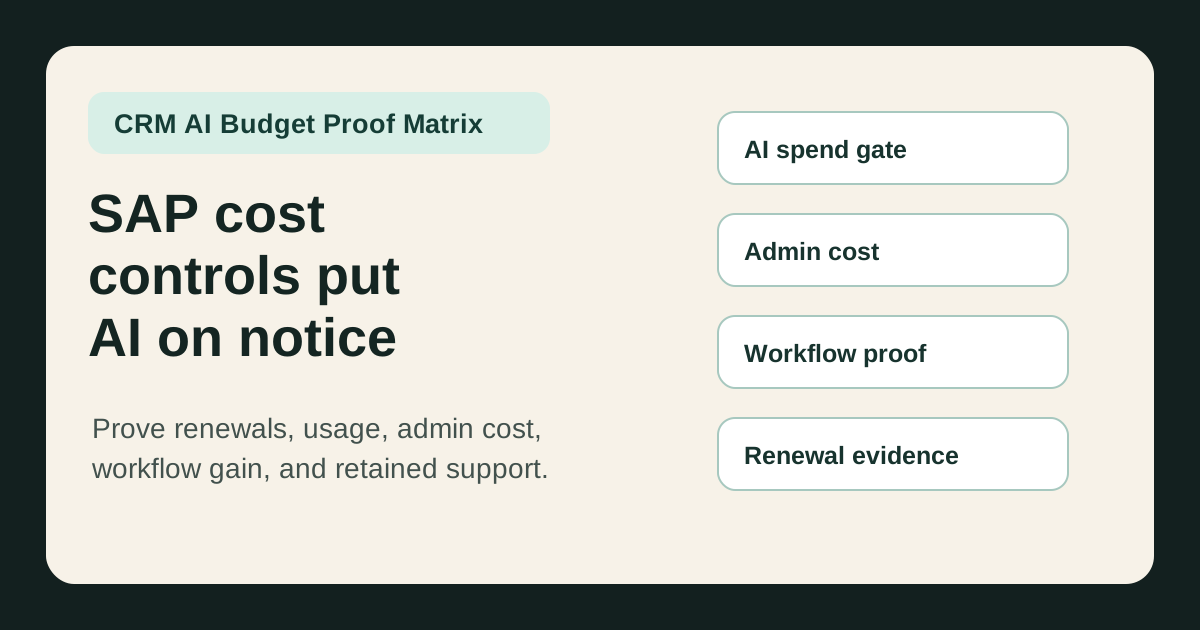
CRM AI Budget Proof Matrix
A buyer framework for deciding which CRM, helpdesk, admin, integration, and AI costs to approve, pause, renegotiate, or prove before renewal.
Require a before-and-after cost model with workflow volume, total AI cost, retained staffing, QA time, and customer outcome metrics.
Fund targeted cleanup and field governance before scaling AI workflows or renewing low-use admin tools.
Tie AI pilots to queue aging, reopen rate, handle time, escalation quality, QA misses, and completion of follow-up tasks.
Keep named owners for exceptions, refunds, complaints, callbacks, account-specific cases, and failed automation.
Build a renewal packet with usage evidence, feature adoption, admin load, AI pilot proof, support impact, and exit risk.
What buyers should do next
Buyer FAQs
What did SAP reportedly change?
WSJ and MarketWatch reported that SAP is applying greater discipline to hiring, external spending, and internal travel so it can continue investing in AI-related capabilities, talent, and technologies.
Why does this matter to CRM buyers?
SAP's cost discipline shows that even large software vendors are forcing AI spend through budget tradeoffs. CRM buyers should do the same by requiring proof before approving AI add-ons, admin work, and renewals.
What proof should support teams ask for?
Ask for usage evidence, workflow savings, data-quality improvements, admin effort, retained human coverage, QA outcomes, and renewal or exit-cost analysis.