

Direct answer
Salesforce WARN layoffs CRM coverage cost map AI admin support: what CRM buyers should take from it
The San Francisco Chronicle reported on August 6, 2026 that Salesforce filed another California WARN notice covering 74 San Francisco employees effective October 5, 2026, its fourth San Francisco layoff round in under a year. The San Francisco Business Times independently reported the 74-employee filing and executive reshuffle, and GeekWire reported related Seattle-area cuts while citing the San Francisco notice. CRM buyers should treat the story as a coverage-cost test: AI roadmap claims and vendor restructuring do not lower total cost unless admin capacity, workflow ownership, support continuity, license economics, and recovery evidence are visible.
Published 8/7/2026. News event: 8/6/2026.
What happened
- The San Francisco Chronicle reported that Salesforce plans another San Francisco layoff round affecting 74 employees at 415 Mission Street, effective October 5, 2026.
- The Chronicle reported the affected functions as 37 technology and product positions, 34 general administration positions, and three sales and distribution positions.
- The same coverage described the filing as Salesforce's fourth San Francisco layoff round in under a year after prior rounds in September 2025, February 2026, and June 2026.
- The San Francisco Business Times independently reported the 74-employee state notice and connected it to an executive reshuffle that included Miguel Milano's promotion to COO.
- GeekWire reported that Salesforce is cutting 59 employees across Seattle and Bellevue and cited the San Francisco Business Times report on the 74 headquarters layoffs.
- California's EDD WARN page explains the broader state notice context, including the general triggers and 2026 worker-support notice requirements.
Why this is trending
- The story is current and supported by state-filing coverage plus independent business and regional reporting.
- Salesforce remains a core CRM and support platform for many buyers, so repeated cuts are not just a labor-market story.
- The layoff round lands as Salesforce continues to push AI and Agentforce economics, making buyers ask whether platform cost shifts into admin, integration, QA, and partner labor.
- CRM teams already face data cleanup, automation ownership, AI pilot governance, support ticketing, and renewal pressure. Vendor restructuring can make those hidden costs more visible.
The CRM Costs take
A CRM buyer should not read repeated vendor layoffs as an automatic reason to leave or an automatic reason to trust AI savings. The buyer needs a CRM Coverage Cost Map showing what the vendor roadmap changes, what internal admins still own, which workflows break when releases or support models change, how AI add-ons affect the bill, where partner or outsourced support is needed, and what evidence proves the stack still works.
CRM Coverage Cost Map
A CRM and support-ops buyer framework for validating CRM total cost when a major software vendor restructures around AI, including roadmap risk, admin capacity, workflow ownership, license economics, support continuity, and evidence closeout.
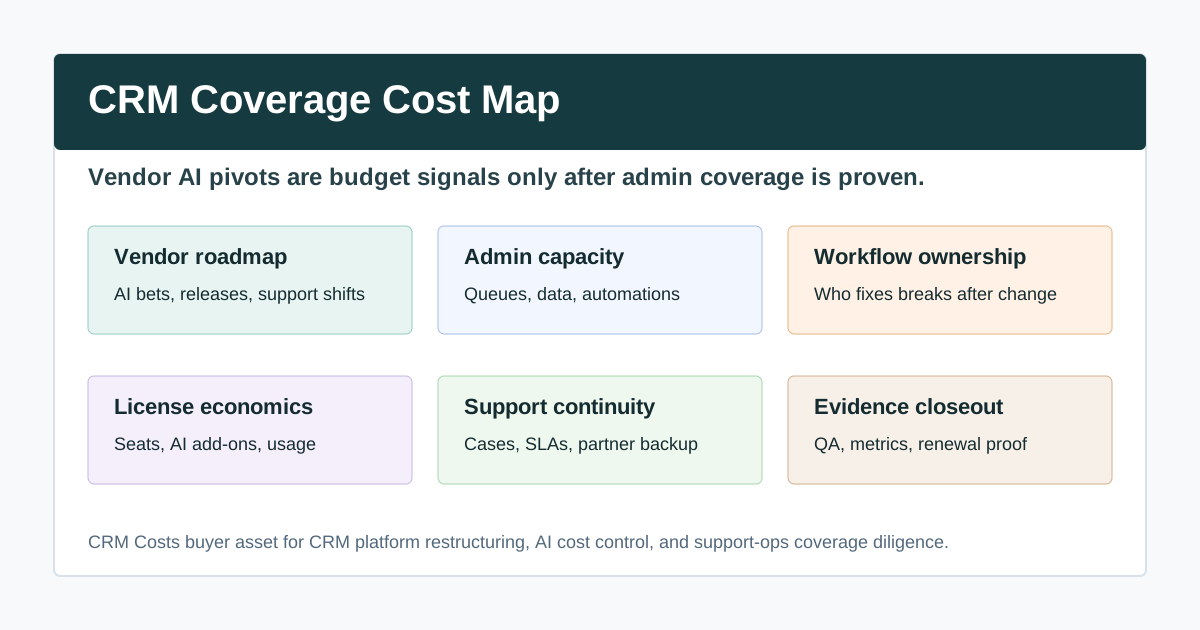
Build a roadmap watchlist with critical workflows, vendor announcements, release windows, and accountable internal owners.
Estimate admin hours for cleanup, configuration, testing, QA, user enablement, support, and rollback before counting savings.
Assign workflow owners, escalation paths, support partners, QA samples, and change logs for every critical CRM process.
Model seats, add-ons, usage, integration costs, admin labor, outsourced support, and renewal terms in one total-cost view.
Create internal support queues, partner backup, issue tags, response SLAs, and customer-impact triage for CRM failures.
Track QA samples, cycle time, failed automations, reopened cases, support load, admin backlog, user adoption, and renewal proof.
What buyers should do next
Buyer FAQs
What did the latest Salesforce layoff reports say?
The San Francisco Chronicle reported that Salesforce filed a California WARN notice for 74 San Francisco employees effective October 5, 2026. The San Francisco Business Times independently reported the notice, and GeekWire reported related Seattle-area Salesforce cuts.
Why does this matter to CRM buyers?
Salesforce is a core CRM and support platform for many teams. Repeated restructuring and AI roadmap shifts can change admin workload, support continuity, workflow ownership, license economics, and renewal leverage.
What proof should buyers ask for first?
Ask for a CRM Coverage Cost Map covering roadmap risk, admin capacity, workflow ownership, license economics, support continuity, and evidence closeout.