

Direct answer
Salesforce Listen Labs Deal Makes Customer Evidence a CRM Gate: what CRM buyers should take from it
Salesforce's proposed Listen Labs acquisition puts customer research closer to CRM and AI workflows. Support buyers should preserve the origin of every insight: human interview, model summary, synthetic response or observed service outcome. Our Customer Evidence Provenance Map keeps those categories separate and requires a human decision owner before simulated feedback becomes policy, automation or a performance claim.
Published 10/1/2026. News event: 9/29/2026.
What happened
- Salesforce announced a definitive agreement to acquire customer-research and human-simulation platform Listen Labs on September 29, 2026.
- The announcement describes AI-assisted study design, participant recruitment, interviewing and synthesis, alongside simulated customer responses.
- Salesforce says the planned acquisition complements Marketing Cloud and Service Cloud. It expects closing in its fiscal fourth quarter of 2027, subject to customary conditions and regulatory clearance.
- MarTech independently covered the agreement on September 30 and noted that integration details have not been announced.
- The announced transaction should not be described as completed, nor as proof that any specific support workflow or integration is available today.
Why this is trending
- An acquisition connects a research platform to a major CRM ecosystem, making this a broader buying and governance event than a feature release.
- Support teams already mix tickets, survey answers and AI summaries in decisions about staffing, retention and knowledge content.
- Simulated customer responses add a different evidence category: a forecast can be useful without being a real customer's statement.
- Losing provenance makes a convincing generated answer look like observed demand, which can distort budgets and policy.
The CRM Costs take
Use the Customer Evidence Provenance Map in your research-to-CRM procurement review. A support director should be able to trace a recommendation back to its evidence type, cohort, collection date and model transformation. For example, a simulated cancellation response may suggest a retention experiment, but it should not count as a verified customer complaint or justify changing every account's offer. The following controls are our illustrative framework; they are not a claim that Salesforce or Listen Labs currently implements each one.
Customer Evidence Provenance Map
Salesforce's Listen Labs agreement raises a CRM buyer question: which insights came from people, models or simulations?
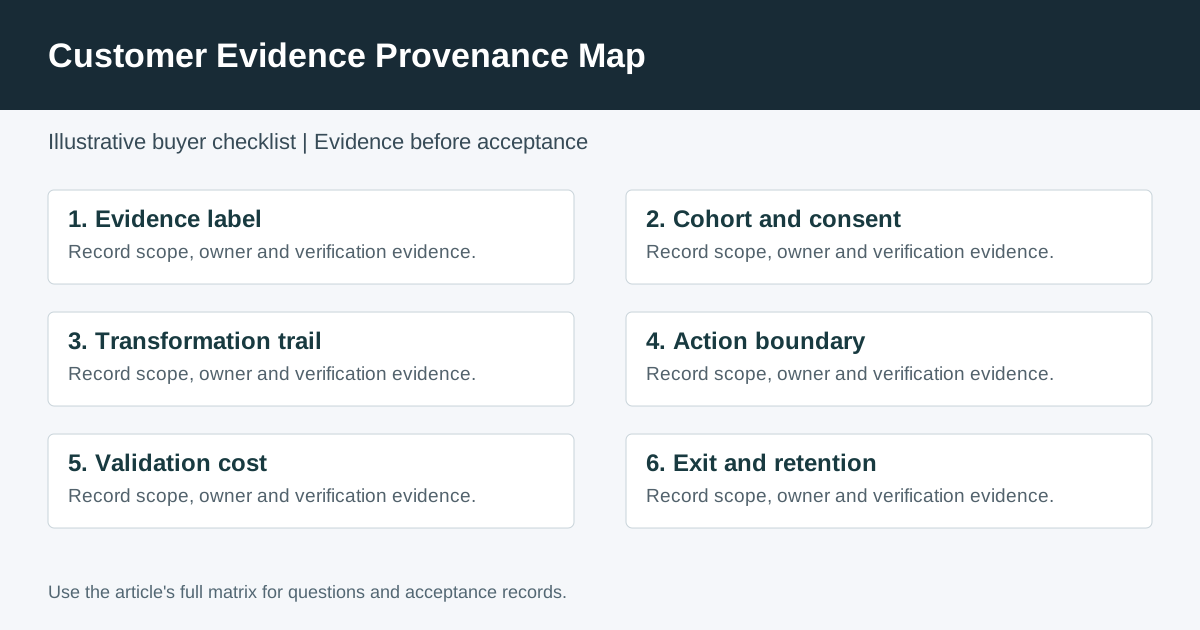
Carry a source-type field through exports, reports and agent context.
Retain recruitment criteria, sample limits, collection date and approved uses.
Keep source identifiers, model/version details and correction history.
Require human approval for consequential changes and isolate exploratory simulations.
Budget a real-world experiment with outcome measures and a stop criterion.
Test an export, access revocation and deletion workflow before contracting.
What buyers should do next
Buyer FAQs
Has Salesforce completed the Listen Labs acquisition?
The September 29 announcement describes a definitive agreement, with expected closing in fiscal Q4 2027 subject to conditions. It does not announce a completed acquisition.
Are simulated customers equivalent to interviewed customers?
No. A simulation estimates a response; an interview records a participant's answer. Both can inform research, but they require different labels and validation.
What should Support Ops buyers request first?
Ask for a sample recommendation that traces evidence type, cohort, source record, model transformation and approved CRM action end to end.