

Direct answer
Salesforce AI control plane CRM agent cost map: what CRM buyers should take from it
Salesforce's Enterprise AI Harness turns AI agent control into a CRM cost question. The company says its new AI Control Plane is meant to discover and register agents, set identity and policy, manage lifecycle, evaluate performance, observe outcomes and control cost across Salesforce and third-party AI. CRM buyers should respond by mapping every customer-facing or record-writing agent to an owner, allowed data, allowed actions, logs, review cadence, rollback path and budget before treating agentic AI as a savings line.
Published 9/12/2026. News event: 9/10/2026.
What happened
- Salesforce announced the Enterprise AI Harness on September 10, 2026, describing six capabilities across context, agency, action, governance, security and models.
- The announcement says the new AI Control Plane will help businesses discover and register agents, establish identity and policy, manage lifecycle, evaluate performance, observe behavior and outcomes, and control cost.
- Salesforce says the architecture is intended to work with Salesforce technology, existing customer technology, third-party models, agents and systems.
- The same announcement says many foundation technologies are available today, with new capabilities and a unified experience planned to begin rolling out in early fiscal FY28.
- MarketWatch reported September 11 that Salesforce's AI strategy is drawing investor attention ahead of Dreamforce, including the Claudeforce partnership with Anthropic.
- MarketWatch also reported analyst questions about whether accessing Salesforce data through Claude changes how customers view and pay for the Salesforce platform.
Why this is trending
- The announcement gives CRM teams a visible control-plane label for work that was already becoming expensive: agent inventory, permissions, monitoring, cost control and lifecycle governance.
- Agentic CRM workflows increasingly touch customer records, contracts, entitlements, refunds, order changes, support tickets, escalations and field updates.
- The story lands before Dreamforce, when Salesforce buyers, investors and partners are watching how Agentforce, Claude, Slack, Data 360 and third-party AI fit together.
- A control plane sounds like software, but the cost also includes admin cleanup, security review, QA sampling, incident response and business-owner time.
- Buyers need proof of what each agent can and cannot do before accepting projected savings from reduced seats, faster case handling or lower support effort.
The CRM Costs take
A CRM buyer should not evaluate agentic AI only by demo quality or license price. Ask how the provider will register agents, assign owners, limit context, authorize actions, monitor outcomes, retire stale agents, price usage, and export audit evidence. If those controls are unclear, the AI cost model is incomplete even when the workflow looks impressive.
CRM Agent Control Cost Map
A CRM and support-ops buyer map for budgeting AI agent registry work, identity policy, context controls, action scope, monitoring, lifecycle management and spend ownership.
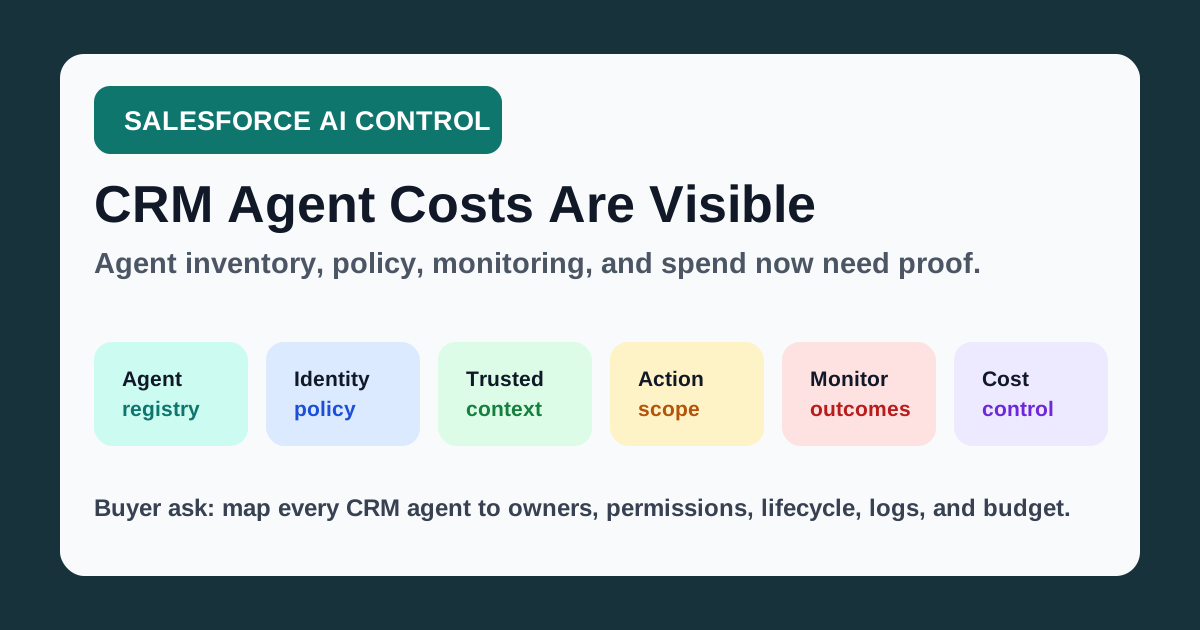
Create an agent inventory with owner, purpose, model route, data access, action scope, deployment date and retirement rule.
Separate read, draft and write permissions; require human approval for sensitive account, money or compliance actions.
Minimize field access, document source systems, mark regulated fields and test whether excluded data stays excluded.
Classify actions by reversibility, dollar impact, customer impact and required approval before production use.
Track outcomes, overrides, incidents, customer corrections, blocked actions and QA samples in one review packet.
Assign budget owners, monthly usage review, release gates, retirement criteria and rollback evidence.
What buyers should do next
Buyer FAQs
Is Salesforce's AI Control Plane generally available now?
Salesforce says many foundation technologies are available today, while new capabilities and a unified experience are planned to begin rolling out in early fiscal FY28. Buyers should base purchasing decisions on currently available products and contract terms.
Why is this a CRM cost story instead of only a platform story?
Because control-plane value depends on real operating work: registry upkeep, permission review, field minimization, QA evidence, monitoring, escalation design, incident response and budget ownership.
What should a buyer ask before enabling action-taking agents?
Ask for the agent identity, owner, allowed data, allowed actions, blocked actions, human approval rules, monitoring signals, audit export, rollback path and cost owner.