

Direct answer
Salesforce Help Agent pay per resolution: what CRM buyers should take from it
Salesforce announced Agentforce Help Agent on June 25, 2026, positioning it as a prepackaged autonomous service agent with guided setup across voice, web, portal, and messaging channels. Salesforce says organizations pay only when the agent autonomously resolves an issue from start to finish, with no charge when the customer gives negative feedback or asks for human escalation. CRM buyers should treat the model as a measurement challenge: define what a resolution means before counting it as savings.
Published 6/26/2026. News event: 6/25/2026.
What happened
- Salesforce said Agentforce Help Agent is built on Agentforce 360 and is designed to resolve customer issues from start to finish.
- The announcement says the agent can be deployed across channels including voice, web, portal, and messaging from a single setup flow.
- Salesforce says pay-per-resolution pricing becomes available in July 2026, alongside Agentforce Help Agent and Agentforce Customer Service Portal general availability.
- CMSWire independently covered the launch and framed outcome-based pricing as part of a broader shift in AI service-agent economics.
Why this is trending
- Outcome pricing is an easy headline because it promises to charge for resolved support work instead of seats, tokens, or interactions.
- The launch follows Salesforce's agreement to acquire Fin, which keeps attention on autonomous customer-service agents and resolution claims.
- Support leaders are under pressure to prove AI ROI, but resolution quality, customer trust, and retained human workload are harder to measure than containment.
The CRM Costs take
A CRM or support operations buyer should not treat pay-per-resolution pricing as automatically cheaper. It can be useful only when the resolution definition is strict, customer feedback is captured, reopened issues are reconciled, and humans are staffed for escalation, QA, cleanup, and complex cases.
Resolution-Pricing Proof Map
A buyer framework for testing whether pay-per-resolution AI support pricing actually reduces cost after reopens, escalations, QA, credits, and retained staff work are included.
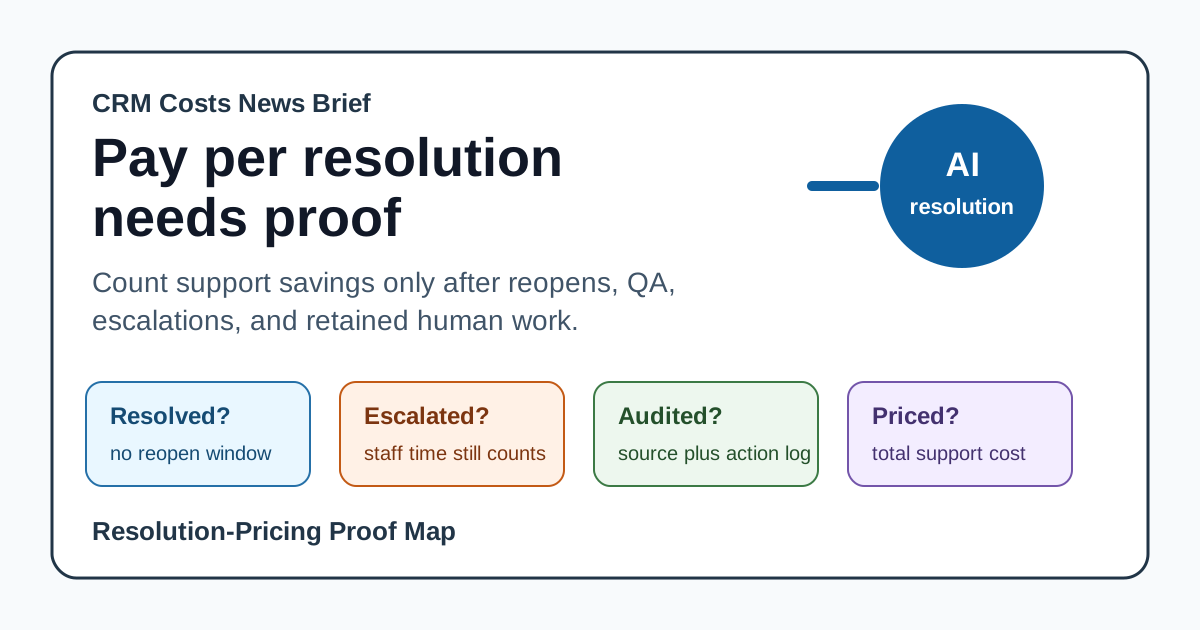
Define resolution with customer confirmation, no reopen window, correct CRM update, and accepted next step.
Budget the retained escalation team and track transfer quality, wait time, and post-transfer outcome.
Clean high-impact CRM and knowledge fields before enabling autonomous resolution.
Require transcript, source, action log, and human review samples for charged resolutions.
Model software, AI resolutions, implementation, QA, admin, escalation, and outsourced support together.
What buyers should do next
Buyer FAQs
What did Salesforce announce?
Salesforce announced Agentforce Help Agent, a prepackaged autonomous service agent with guided setup across channels and pay-per-resolution pricing for issues resolved from start to finish.
When is pay-per-resolution pricing available?
Salesforce says Agentforce Help Agent, Agentforce Customer Service Portal, and pay-per-resolution pricing are generally available in July 2026.
Is pay-per-resolution cheaper than support seats?
Not automatically. Buyers must include AI charges, implementation, CRM cleanup, QA, knowledge maintenance, human escalation, and reopened cases in the model.
What should buyers measure first?
Measure whether the AI resolution stays resolved: no reopen, no callback, correct record update, acceptable customer feedback, and clean escalation when needed.