

Direct answer
Salesforce Agentforce downgrade KeyBanc Bernstein customer feedback July 2026 CRM data readiness: what CRM buyers should take from it
Investor's Business Daily, Barron's, MarketWatch, and other market outlets reported that KeyBanc downgraded Salesforce on July 9, 2026, citing weak Agentforce momentum and customer feedback. TheStreet reported a second downgrade from Bernstein the same day. CRM buyers should treat the market reaction as an operating checklist: do not approve AI-agent spend until the CRM data, workflow scope, evaluation evidence, human escalation, and cost model are proven.
Published 7/12/2026. News event: 7/9/2026.
What happened
- Investor's Business Daily reported that KeyBanc downgraded Salesforce from overweight to sector weight and cited underwhelming customer feedback around Agentforce.
- Barron's reported that KeyBanc analyst Jackson Ader pointed to lackluster customer feedback and weak momentum around Salesforce's AI agent offering.
- MarketWatch reported that the analyst questioned whether Salesforce's data quality and customer activity around Agentforce supported a near-term upside case.
- TheStreet reported that both KeyBanc and Bernstein downgraded Salesforce on July 9, framing it as a double blow tied to AI-product concerns.
- The buyer lesson is not whether Salesforce stock is cheap or expensive. It is whether an AI agent can operate on the buyer's real CRM data without creating cleanup, escalation, and renewal-cost surprises.
Why this is trending
- Agentforce is one of the most visible enterprise AI-agent bets, so weak customer-check commentary travels beyond investors into CRM and support-operations teams.
- The downgrade story connects AI-agent hype with the data reality buyers face: incomplete records, duplicate contacts, stale lifecycle stages, broken integrations, and unclear tool permissions.
- CRM software buyers are under pressure to fund AI pilots while also proving total cost, support quality, and customer-data governance.
The CRM Costs take
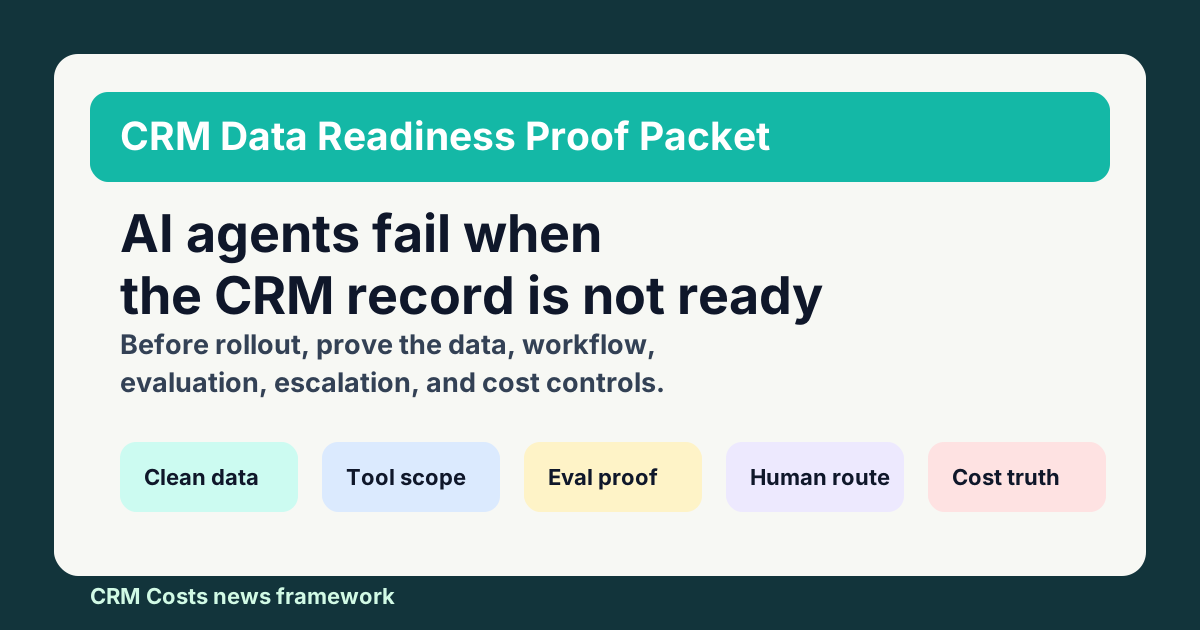
A CRM buyer should not approve AI-agent licenses, resolution pricing, or implementation work because the demo looks capable. The buyer needs a CRM Data Readiness Proof Packet: clean records, source fields, tool permissions, allowed actions, workflow owner, evaluation set, escalation path, QA samples, rework tracking, and renewal economics.
CRM Data Readiness Proof Packet
A buyer framework for validating AI agent rollouts across clean data, tool scope, workflow ownership, evaluation evidence, human escalation, cost proof, and renewal discipline.
Run a CRM hygiene sample before rollout: duplicate rate, missing required fields, stale stages, orphan cases, and sensitive-field exposure.
Document allowed tools, blocked actions, approval thresholds, rollback rules, and audit logs for each workflow.
Create a workflow RACI for routing, escalation, data correction, customer callback, and post-case cleanup.
Build an evaluation set with redacted real cases, expected outcomes, pass/fail rules, reviewer notes, and regression cadence.
Track reopens, escalations, callbacks, bad outputs, manual corrections, and recovery owner by workflow.
Model license cost, integration cost, cleanup effort, QA time, retained staff, rework, and renewal uplift before expanding.
What buyers should do next
Buyer FAQs
Is the Salesforce downgrade a reason to avoid all CRM AI agents?
No. It is a reason to demand proof. CRM AI agents can be useful, but buyers should prove data readiness, workflow scope, evaluation quality, escalation, and total cost before scaling.
What is the biggest AI-agent risk for CRM buyers?
Dirty or incomplete CRM data. If records, ownership, lifecycle stages, notes, permissions, and integrations are not reliable, the agent can automate confusion faster than a human team can repair it.
What should buyers ask vendors for before rollout?
Ask for data-readiness checks, action-scope controls, real-case evaluation results, human escalation rules, audit logs, rework tracking, and a total-cost model that includes cleanup and retained staff.