

Direct answer
RNLI Beacon CRM breach supporter data cost map: what CRM buyers should take from it
The RNLI and Beacon CRM story makes third-party CRM breach response a support-ops cost issue. When a vendor cannot identify exactly which supporter records or files were accessed, the operating team needs proof of record scope, notification criteria, regulator duties, credential rotation, suspicious-message guidance, response scripts and closure evidence. The cost is not only security investigation. It is the donor, member, volunteer and supporter communication work that follows.
Published 9/21/2026. News event: 9/20/2026.
What happened
- The Guardian reported September 20, 2026 that RNLI warned supporters their names, contact details and records of interactions with the charity may have been affected by the Beacon CRM cyber incident.
- The report said Beacon CRM advised affected organizations, including RNLI, to assume data held in its systems was taken, while there was no evidence that RNLI supporter information had been published, shared online or otherwise misused.
- The Charity Commission said August 7, 2026 that it was monitoring the Beacon CRM incident, expected a high volume of serious incident reports, and encouraged trustees to consider reporting duties to the Commission, ICO and affected individuals.
- The British Deaf Association's public incident notice said Beacon's further forensic findings identified malicious activity beginning July 27, lasting about 1 hour and 27 minutes, with a compromised AWS access key believed to be the most likely cause.
- BDA said Beacon's assessment was that all data in the database, including attachment files, was exported; it also said Beacon could not determine exactly which individual records or files were downloaded.
- For CRM and support buyers, the operating risk is the same pattern: a third-party CRM incident can become a supporter-trust, notification, helpdesk and evidence-retention workload before the final forensic report arrives.
Why this is trending
- The story named a high-profile charity and connected a CRM supplier incident to supporter trust at a moment when RNLI was already facing public pressure.
- Charity, nonprofit and membership CRM records often mix contact details, donation history, event participation, preferences, notes and attachments, which makes risk review more expensive than a simple email list check.
- The inability to identify exact affected records changes the support burden: teams may need to notify broader groups, prepare cautious scripts and handle inbound questions without overclaiming certainty.
- Regulator guidance turns the response into a governance task for trustees, data protection leads, CRM owners and supporter-care teams, not only a vendor security issue.
- The incident gives buyers a practical test for CRM outsourcing and managed-support vendors: can they prove record scope, integrations, access keys, notification workflows and closure packets when a supplier incident lands?
The CRM Costs take
A CRM buyer should treat third-party incident response as an operating workflow with named owners and evidence, not as an after-the-fact apology email. Before approving a CRM, integration partner or outsourced support team, the buyer should ask how records are classified, where attachments live, which integrations hold access keys, who writes supporter notices, which regulator reports are triggered, how suspicious inbound messages are triaged, and what proof closes the incident. Without that map, support teams inherit uncertainty from both the vendor and the customer inbox.
Supporter Data Cost Map
A CRM and support-ops buyer map for budgeting record-scope review, supporter notices, regulator reporting, credential resets, suspicious-message guidance and incident closure proof.
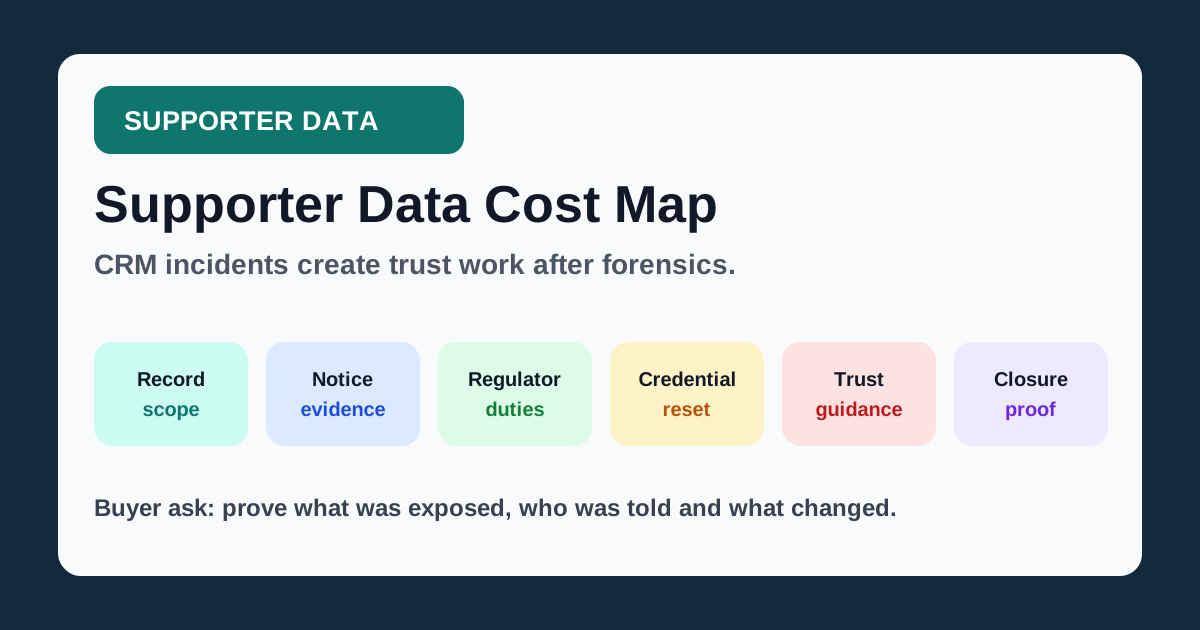
Maintain a data-category register by CRM object, attachment store, integration and retention period before an incident happens.
Prewrite notification criteria, approval owners, message versions, sent lists, suppression rules and evidence logs.
Map reporting thresholds, owners, deadlines, evidence needed and final submission locations in the incident playbook.
Inventory integrations and rotate or revoke tokens, service accounts, browser-profile credentials and downstream exports.
Create suspicious-message guidance, escalation tags, callback verification steps and approved language for uncertainty.
Close with a packet covering data scope, messages, regulator filings, credential actions, inbound-case trends and board-ready lessons learned.
What buyers should do next
Buyer FAQs
Was RNLI supporter data confirmed misused?
The public reporting and affected-organization notices said there was no evidence that RNLI supporter information had been published, shared online or otherwise misused. The support-ops issue is the cost of responding when exposure is possible but exact records cannot be confirmed.
Why is this a CRM operations story?
CRM systems hold contact, donation, interaction, preference and attachment data. A supplier incident therefore creates notification, regulator, helpdesk, credential, integration and trust-repair work for the operating team.
What should buyers ask a CRM or support partner now?
Ask for the data-category register, integration inventory, incident-notice workflow, regulator reporting owner, token-rotation plan, inbound support scripts and closure-packet template.