

Direct answer
RentGrow FTC 2.25 million FCRA tenant screening data accuracy July 2026 support workflow: what CRM buyers should take from it
The FTC said on July 9, 2026 that RentGrow, a tenant-screening consumer reporting agency, will pay $2.25 million to settle allegations it violated the Fair Credit Reporting Act and FTC Act. The FTC alleged failures around reasonable procedures for maximum possible accuracy, duplicate criminal or eviction records, data-source disclosures, dispute handling, and misleading dispute-outcome notices. Support-ops buyers should treat the case as a data accuracy proof test for any workflow where records affect customer decisions.
Published 7/10/2026. News event: 7/9/2026.
What happened
- The FTC announcement said RentGrow provides consumer reports for tenant screening and will pay a $2.25 million monetary penalty under a proposed order filed by the DOJ.
- The FTC said the complaint alleged RentGrow failed to maintain reasonable procedures to assure maximum possible accuracy in consumer reports.
- The agency alleged duplicate case records and multiple entries for the same criminal or eviction action could make applicants appear to have more convictions or eviction suits than they actually had.
- The FTC also alleged source-disclosure failures made it harder for consumers to dispute inaccurate data and that some dispute outcomes were misrepresented to consumers or property managers.
- FTC business guidance explains that tenant background screening companies covered by the FCRA must follow accuracy, disclosure, and dispute-investigation requirements.
Why this is trending
- The penalty is tied to real workflow mechanics: duplicate records, source visibility, dispute intake, corrected reports, and notices to downstream decision makers.
- Automated support and back-office systems increasingly combine CRM records, public records, vendor enrichment, AI summaries, identity checks, and workflow decisions.
- When bad records are repeated across tools, support teams become the recovery layer customers need, but many teams cannot prove source, correction, or notification history.
The CRM Costs take
A support-ops buyer should not approve automated screening, enrichment, case scoring, fraud review, collections, eligibility, or CRM decision workflows only because the data provider is reputable. The buyer needs a data accuracy support proof packet: duplicate-record controls, source disclosure, dispute queue, correction notice, downstream-recipient update, audit trail, human escalation, and customer recovery evidence.
Data Accuracy Support Proof Packet
A buyer framework for validating automated decision workflows across duplicate-record checks, source disclosure, dispute triage, correction notices, audit logs, and human escalation.
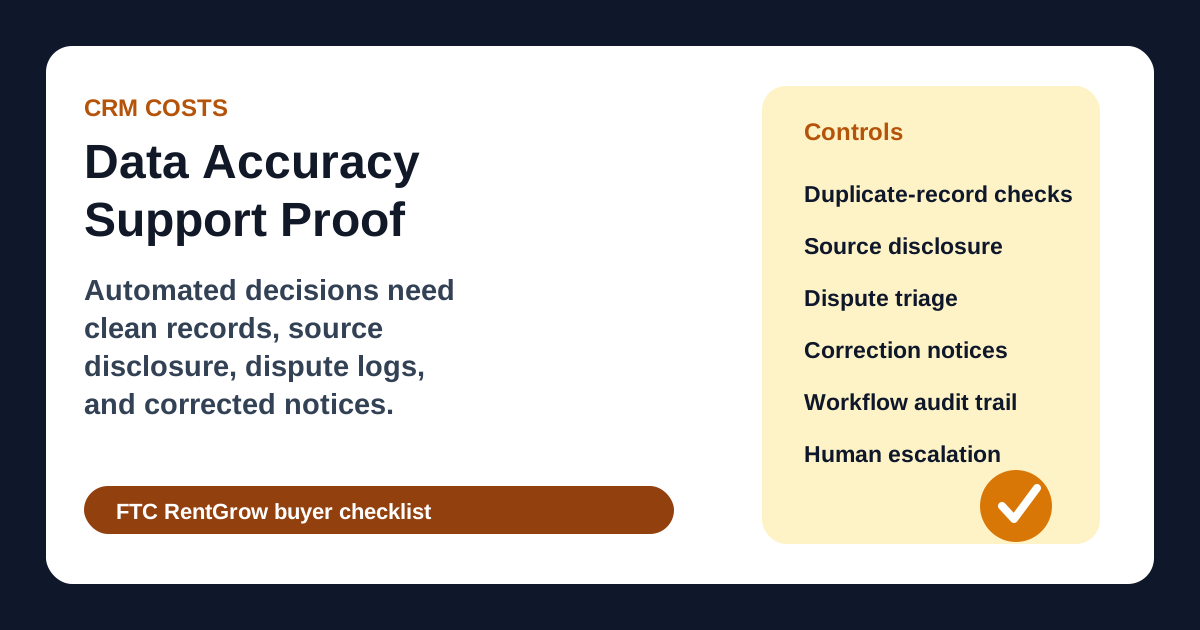
Create duplicate detection rules, manual review queues, suppression notes, QA sampling, and a named data-quality owner.
Require source fields, vendor names, timestamps, matching logic, field-level provenance, and exportable disclosure notes.
Build a dispute queue with issue type, deadline, owner, evidence requested, investigation result, and escalation path.
Preserve corrected-report notices, recipient lists, timestamps, notice copy, resend status, and confirmation evidence.
Capture record snapshots, source exports, dispute notes, correction logs, downstream notices, and QA review evidence.
Define stop-action triggers, supervisor review, sensitive-case escalation, customer callback, and temporary hold rules.
What buyers should do next
Buyer FAQs
Is the RentGrow case only relevant to tenant screening?
No. The legal allegations are about tenant-screening consumer reports, but the operating lesson applies anywhere support teams depend on records that can duplicate, mismatch, omit sources, or require customer dispute handling.
What does data accuracy mean for support operations?
It means the support team can show where a record came from, why it was matched to the customer, whether duplicates were suppressed, how disputes are investigated, who receives corrections, and what audit trail proves recovery.
What should buyers ask vendors before using automated records?
Ask for duplicate controls, source disclosure, dispute workflow, correction notices, downstream-recipient updates, audit exports, human escalation triggers, and sample evidence from corrected cases.