

Direct answer
Origin Energy customer data breach support response proof map: what CRM buyers should take from it
Origin Energy said in July 2026 that it was investigating a potential security incident involving unauthorized access to customer data and had notified Australian authorities. ABC reported Origin did not believe credit card or bank details were included at that point, while The Guardian later reported that addresses, phone numbers, and partial payment information were among the data categories accessed. CRM and support-ops buyers should treat the incident as support-response proof work: customers need accurate notices, scam guidance, identity-safe verification, queue handling, escalation, and closeout evidence.
Published 8/5/2026. News event: 7/23/2026.
What happened
- Origin published a July 2026 update saying it was investigating a potential security incident involving unauthorized access to customer data.
- ABC reported on July 22 that Origin had notified the Australian Cyber Security Centre and Australian Federal Police.
- ABC reported Origin's statement that the company did not believe impacted data included credit card or bank details at that point.
- The Guardian independently reported on July 23 that addresses, phone numbers, and partial payment information were among customer data categories accessed.
- The Guardian also reported that the exact number of affected customers had not been confirmed in the reporting available at that time.
- Both the customer-data scope and the scam-risk response make the story a support-operations issue, not only a security-team incident.
Why this is trending
- The incident involved a large consumer utility brand with customer records, payment context, and high customer-anxiety potential.
- The coverage combined an official company update, national broadcaster reporting, and independent newspaper reporting rather than a single rumor.
- Breach response often lands first in support queues: customers ask whether they are affected, which details were exposed, what to ignore, and how to verify legitimate contact.
- Support teams can create new risk during a breach if agents ask for too much information, give inconsistent answers, or fail to tag scam reports and escalation paths.
The CRM Costs take
A CRM or support buyer should not evaluate breach response only by whether security contained the incident. The buyer needs a Customer Data Support Response Map showing what data is confirmed, what agents may say, how customers are verified without over-sharing, which scam scripts are used, which queues capture affected customers, and what evidence proves the response was consistent.
Customer Data Support Response Map
A CRM and support-ops buyer framework for validating breach-response support across data scope, customer notices, scam defense, identity-safe verification, queue routing, escalation, and evidence closeout.
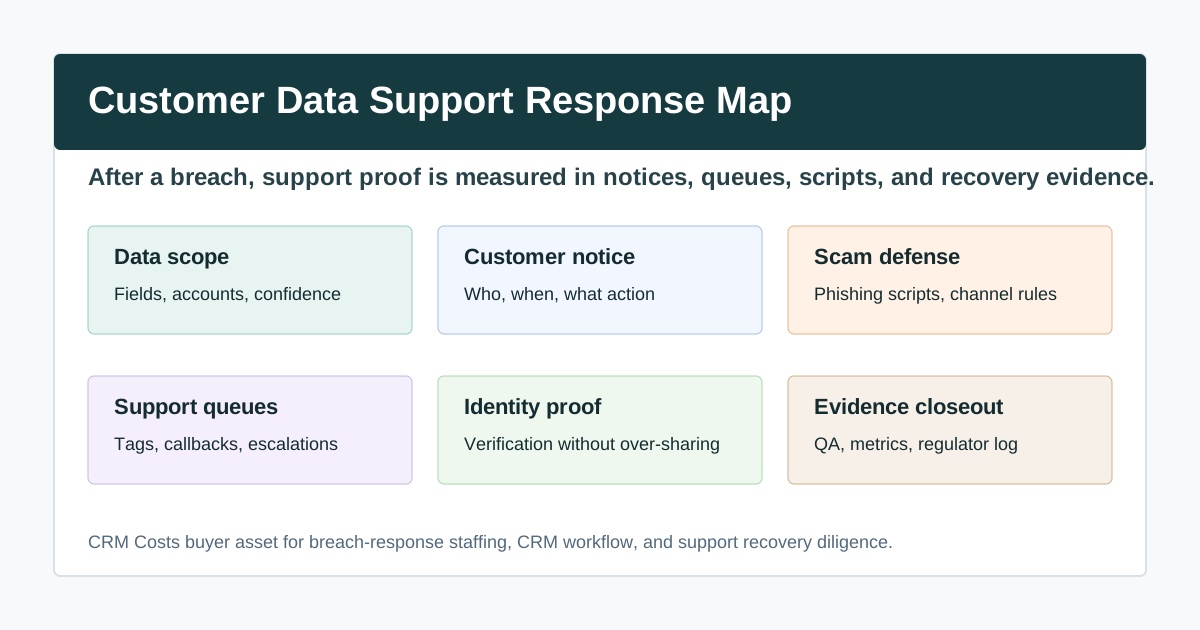
Publish a field-level response matrix with confirmed fields, excluded fields, unknowns, source date, and legal owner.
Align notice copy, help-center copy, call scripts, email templates, and escalation wording before volume spikes.
Create scam-defense scripts with approved domains, phone numbers, no-payment rules, and suspicious-contact reporting.
Switch to breach-safe verification prompts, step-up rules, callback controls, and supervisor review for edge cases.
Add breach tags, affected-account flags, scam-report categories, callback queues, and SLA owners.
Keep versioned scripts, QA samples, send logs, escalation notes, regulator milestones, and post-incident metrics.
What buyers should do next
Buyer FAQs
What did Origin Energy report?
Origin said it was investigating a potential security incident involving unauthorized access to customer data and had notified Australian authorities.
Why does this matter to support operations?
Customers need reliable answers, scam guidance, identity-safe verification, and escalation paths after a data incident. Those needs land in CRM, helpdesk, phone, chat, and email queues.
What proof should buyers ask for first?
Ask for a Customer Data Support Response Map covering data scope, notices, scam scripts, breach-safe verification, support queue tags, escalation, QA, and evidence closeout.