

Direct answer
Oracle 21,000 jobs AI restructuring: what CRM buyers should take from it
Oracle filed its fiscal 2026 Form 10-K on June 22, 2026. The filing says Oracle employed about 141,000 full-time employees as of May 31, 2026, and reported $1.838 billion in restructuring and other expenses for fiscal 2026. The same filing says adoption and deployment of AI technologies across operations have resulted, and may continue to result, in workforce reductions. For CRM and support operations leaders, the trend is clear: do not count AI savings until the retained operating layer is priced.
Published 6/25/2026. News event: 6/22/2026.
What happened
- Oracle's fiscal 2026 10-K says the company employed approximately 141,000 full-time employees as of May 31, 2026.
- The prior-year 10-K said Oracle employed approximately 162,000 full-time employees as of May 31, 2025, which is why the headcount drop is being covered as roughly 21,000 roles.
- Oracle reported $1.838 billion in restructuring and other expenses for fiscal 2026, up from $374 million in fiscal 2025.
- The filing says adoption and deployment of AI technologies across operations have resulted, and may continue to result, in workforce reductions.
Why this is trending
- The number is simple and viral: a major enterprise software company reported a 21,000-person headcount drop while AI spending and restructuring costs moved higher.
- The story gives executives a boardroom version of the same question support teams face: what work disappears, what work moves, and what work becomes more expensive when AI replaces people?
- Support operations leaders are under pressure to automate, but customer risk often shows up after the headcount model is approved.
The CRM Costs take
A CRM or support buyer should not copy Oracle's restructuring playbook. The useful move is to price the operating layer before cutting seats or outsourcing the wrong work. AI may remove routine work, but it often creates new controls around data quality, exception handling, customer escalation, QA sampling, agent training, and audit evidence.
AI Restructuring Support Cost Map
A buyer framework for testing whether AI replacement plans actually reduce support cost after escalation, QA, data cleanup, compliance, retraining, and customer-impact work are included.
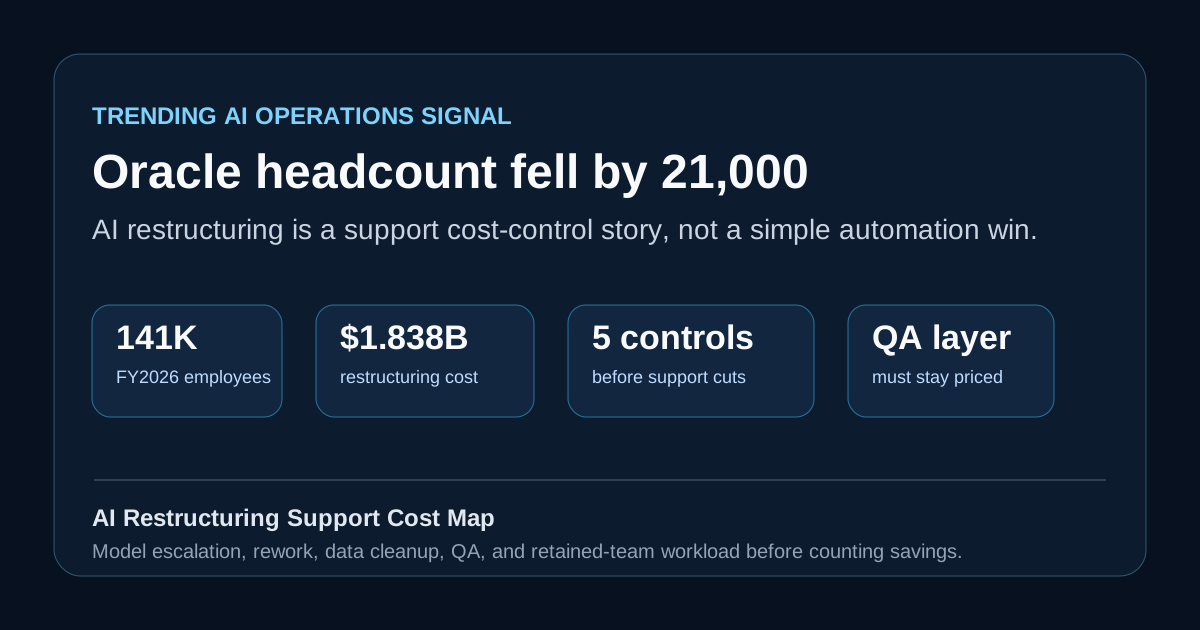
Break the plan into resolved-by-AI, assisted-by-AI, human-only, and outsourced lanes before cutting coverage.
Staff escalation capacity by complexity, not by old ticket volume.
Track rework, reopened cases, false resolution, transfer quality, and correction time in the AI pilot.
Clean the fields AI depends on before replacing support capacity.
Publish ownership rules, reskill retained staff, and make escalation quality part of the savings model.
What buyers should do next
Buyer FAQs
Did Oracle say AI caused workforce reductions?
Oracle's fiscal 2026 Form 10-K says adoption and deployment of AI technologies across operations have resulted, and may continue to result, in reductions to its workforce.
Why does this matter for support operations buyers?
It shows that AI savings are not just a software feature decision. Buyers need to price the retained operating layer, including escalation, QA, data cleanup, training, and customer-risk controls.
Should a support team replace agents with AI after this news?
Only after proving the workflow. AI can reduce repetitive tasks, but buyers should verify rework, escalation quality, customer outcomes, and retained-team workload before cutting capacity.
What should be checked first?
Start with a queue-level cost map: AI-resolved work, AI-assisted work, human-only work, outsourced support work, QA work, and exception ownership.