

Direct answer
Open Secure AI Alliance AI agent governance support operations evidence map: what CRM buyers should take from it
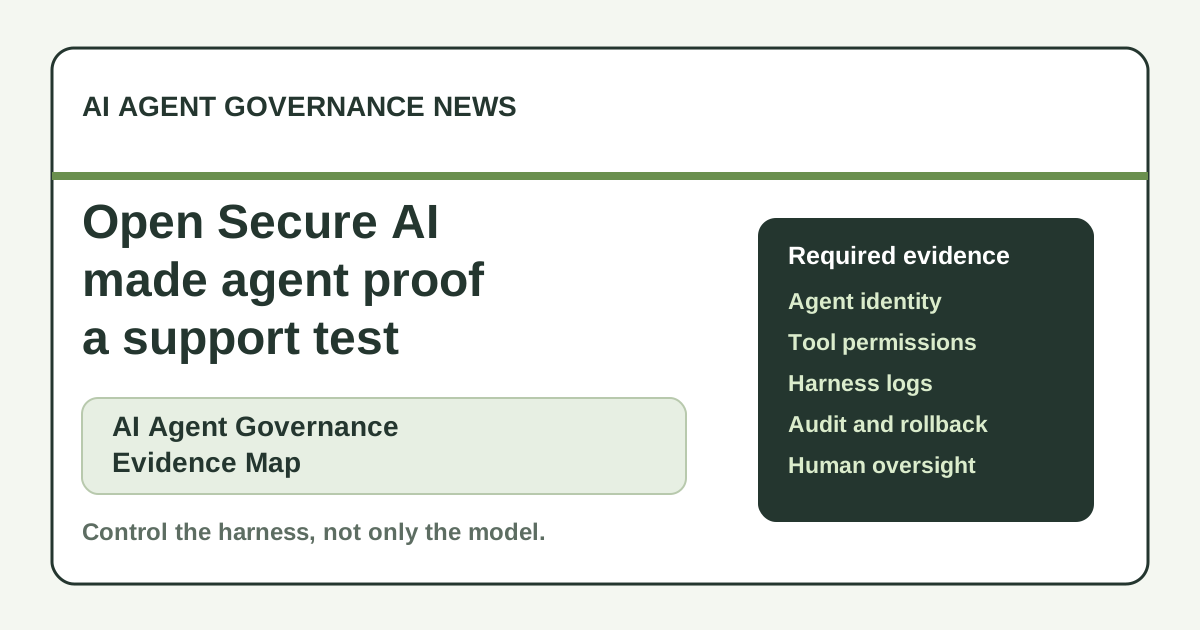
NVIDIA launched the Open Secure AI Alliance on July 27, 2026 and said the alliance will develop and share open technologies, techniques, and tools to safeguard software and agents in the age of AI. NVIDIA and the Linux Foundation both emphasized the agent harness, not just the model: identity, permissions, guardrails, logs, evaluation, testing, tracing, audit, and governance. CRM and support-ops buyers should respond with an AI Agent Governance Evidence Map before allowing AI agents to read, write, summarize, or route customer records.
Published 8/3/2026. News event: 7/27/2026.
What happened
- NVIDIA announced the Open Secure AI Alliance on July 27, 2026 with founding members across cloud, security, enterprise software, open source, and AI research.
- NVIDIA said the alliance mission is to give defenders open tools they can trust and control.
- The NVIDIA announcement framed agent safety around identity, permissions, harnesses, guardrails, logs, evaluation, safe model formats, scanning, and secure coding workflows.
- The Linux Foundation said it joined as an inaugural partner and highlighted NVIDIA Labs Object-Oriented Agent, or NOOA, as a research framework for testing, tracing, auditing, and governing agent behavior.
- The Hacker News independently covered the alliance and described its scope across the agent stack, including identity, permissions, isolation, guardrails, logs, model formats, multi-model scanning, and secure coding workflows.
- The Verge independently covered the announcement and noted that leading closed-model AI labs were absent from the initial alliance coverage.
Why this is trending
- The alliance touches a live buyer concern: support AI agents now connect to CRMs, ticket queues, knowledge bases, identity systems, call summaries, and workflow tools.
- The story moves AI governance from policy language to operating artifacts such as harnesses, logs, permissions, identity, and testable agent behavior.
- Open security tooling is relevant to buyers because closed vendor claims are hard to verify when an AI agent can take actions across customer records.
- Support and CRM leaders need evidence that agent behavior can be traced, audited, constrained, and rolled back when customer workflows fail.
The CRM Costs take
A CRM or support buyer should not approve an AI agent because the model is capable or the vendor says it has guardrails. The buyer needs an AI Agent Governance Evidence Map showing the agent identity, allowed tools, customer-data boundaries, prompt-injection controls, harness logs, audit trail, rollback path, vulnerability response owner, and human oversight rule.
AI Agent Governance Evidence Map
A CRM and support-ops buyer framework for validating AI agent identity, tool permissions, customer-data boundaries, harness logs, auditability, rollback, vulnerability response, and human oversight.
Create named agent identities with owners, purpose, environments, permissions, and revocation rules.
Document read/write scopes, blocked actions, approval gates, rate limits, and sensitive-workflow exclusions.
Classify support data, limit context, exclude sensitive fields, and test exports before production rollout.
Require harness logs with prompt version, context source, tool call, response, policy outcome, and reviewer notes.
Add release approval, scenario regression, rollback trigger, kill switch, and post-change QA sampling.
Create a response plan with security triage, support queue tags, customer notices, recovery scripts, and evidence retention.
What buyers should do next
Buyer FAQs
What is the Open Secure AI Alliance?
NVIDIA announced it as an alliance to develop and share open technologies, techniques, and tools for safeguarding software and agents in the age of AI.
Why does it matter to support operations?
Support AI agents increasingly touch CRM data, ticket queues, knowledge bases, and workflow tools. Buyers need proof of agent identity, permissions, harness logs, auditability, rollback, and human oversight.
What proof should buyers ask for first?
Ask for an AI Agent Governance Evidence Map covering named agent identities, least-privilege tool scope, customer-data boundaries, harness logs, rollback, vulnerability response, and human review.