

Direct answer
NHS breach helpline review November 2026: what CRM buyers should take from it
Royal Cornwall Hospitals NHS Trust's newly published independent review says its response to a staff-data breach included a dedicated contact centre and identifies lessons on preparedness, staff support, consistent communication and resources for high-volume contact operations. Independent reporting on the report says the helpline faced distressed callers and safeguarding decisions. This article does not claim that every incident needs the same response; it gives support buyers a practical way to test readiness before a crisis queue opens.
Published 11/9/2026. News event: 11/5/2026.
What happened
- The Trust published its independent investigation on October 29 after governance review, covering an accidental disclosure of staff sickness-absence information through an FOI spreadsheet.
- The report says the Trust identified the issue in November 2025, notified affected current and former staff, set up a dedicated contact centre and reviewed historic disclosures.
- Its recommendations include appropriate support and resources for staff managing high-volume contact operations, incident planning that considers data-loss events, and timely, consistent, trauma-informed engagement.
Why this is trending
- The independent report was newly published and discussed at the Trust's November board meeting, creating a fresh, source-backed operational case study.
- It moves the discussion beyond generic breach notification: the quality of the live support response affects both affected people and the staff handling difficult conversations.
- The buyer lesson is concrete: a helpline launch needs usable scripts, safeguarding escalation, staffing resilience and a factual case record—not just a phone number.
The CRM Costs take
This is an editorial planning framework, not a finding about a named supplier or a substitute for legal, clinical, security or safeguarding advice. An illustrative support team can rehearse an incident queue with fictional data: identify who approves scripts, who accepts an urgent escalation, how a caller's consent and contact preference are recorded, which team supports the handlers, and how a promised update is carried into the next interaction. The test should reduce burden on affected people and agents; it should not turn a support process into a barrier.
Breach Helpline Readiness Proof Packet
An original six-part buyer checklist for testing whether a high-volume incident helpline can support distressed callers without losing safety, ownership or evidence.
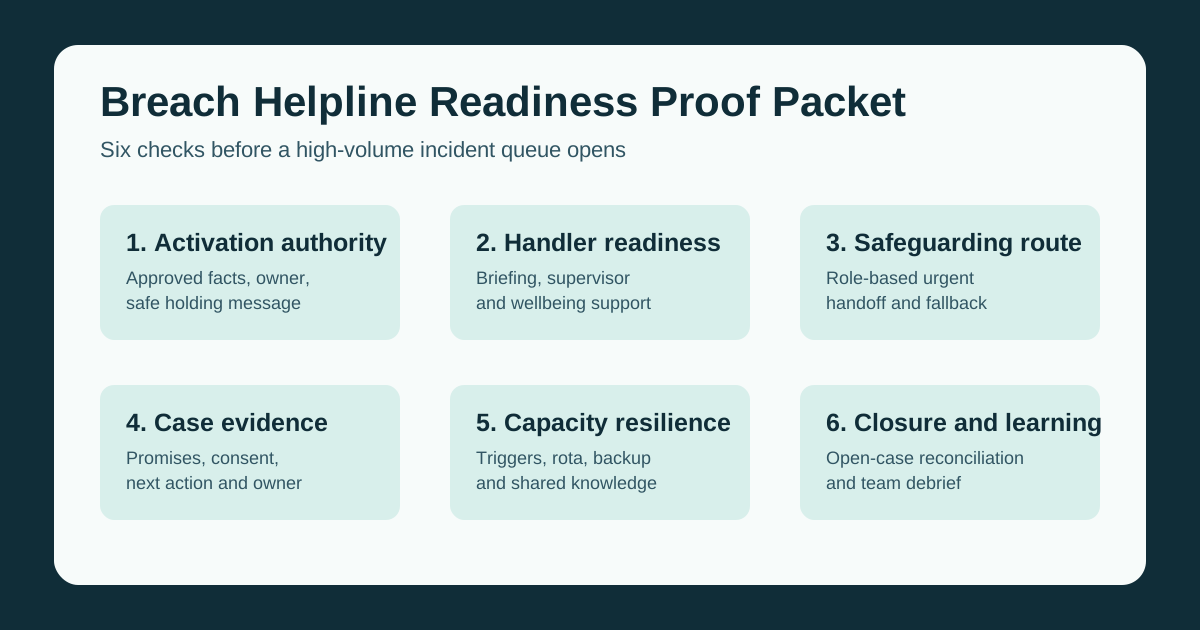
Name an incident owner, script approver, version control and a safe holding message.
Run a short scenario briefing, provide live supervisor support and schedule protected decompression.
Publish a role-based escalation route, handoff criteria and documented fallback.
Record the contact reason, verified facts, promised next action, owner and update time in one controlled case record.
Set capacity triggers, backup roles, handover notes and daily checks on workload and wellbeing.
Reconcile open cases, retain approved evidence and debrief the support team after the incident.
What buyers should do next
Buyer FAQs
Did the review find that the helpline caused the original breach?
No. The report concerns an earlier FOI spreadsheet disclosure. The helpline is part of the subsequent response and the article draws operational lessons from the published review.
Does every support team need a dedicated breach call centre?
No. The appropriate response depends on the incident, affected people and available services. The packet is a readiness test, not a mandate.
Is this safeguarding or legal advice?
No. It is an editorial operations checklist. Safeguarding, privacy, notification and employment decisions need the appropriate qualified owners.
What should a buyer test first?
Test whether an agent can give an approved factual response, document a promised action and reach an authorized escalation owner without improvising.