

Direct answer
Madison Square Garden ShinyHunters customer data risk score Salesforce leak July 2026 support proof: what CRM buyers should take from it
WIRED reported on July 9, 2026 that leaked Madison Square Garden data allegedly published by ShinyHunters included a VIP database with risk labels and a larger customer dataset. Have I Been Pwned lists a Madison Square Garden Sports breach from June 2026 with 9.8 million affected accounts and compromised customer-service records, email addresses, names, phone numbers, and physical addresses. Support-ops buyers should treat the story as a customer-risk-list governance test: prove who can label customers, what sensitive fields are retained, how access is limited, how customers are notified, and how bad records are disputed or suppressed.
Published 7/13/2026. News event: 7/9/2026.
What happened
- WIRED reported that an internal Madison Square Garden database included risk labels for some high-profile visitors and that the material came from a larger ShinyHunters data dump.
- The same WIRED report described a much larger customer database with more than 10.5 million entries and said it appeared to be pulled from a Salesforce customer-management system.
- Have I Been Pwned lists the Madison Square Garden Sports breach as a June 2026 incident with 9.8 million affected accounts, customer-service records, names, emails, phone numbers, and physical addresses.
- WIRED's earlier security roundup said ShinyHunters claimed to publish 45GB of stolen MSG data and noted a class action filed after the alleged breach.
- For support teams, the operating issue is whether internal customer records, tags, risk labels, sensitive fields, and access rights can be governed and corrected when they leave the system of record.
Why this is trending
- The story combines customer data, CRM records, surveillance concerns, VIP risk labels, ShinyHunters, Salesforce-linked access questions, and venue operations in one public incident.
- Customer-risk labels are not abstract metadata. They can affect service, entry, fraud review, callbacks, escalation, offers, and how staff treat a person.
- Many support operations now use AI summaries, CRM enrichment, loyalty flags, fraud tags, security notes, and outsourced access, but cannot prove the lifecycle of sensitive labels after a breach or dispute.
The CRM Costs take
A support-ops buyer should not treat internal risk labels as harmless notes. The buyer needs a Customer Risk List Recovery Packet: record inventory, label owner, allowed fields, sensitive-field exclusions, access roles, retention rule, customer notice template, dispute route, suppression process, and exportable audit evidence.
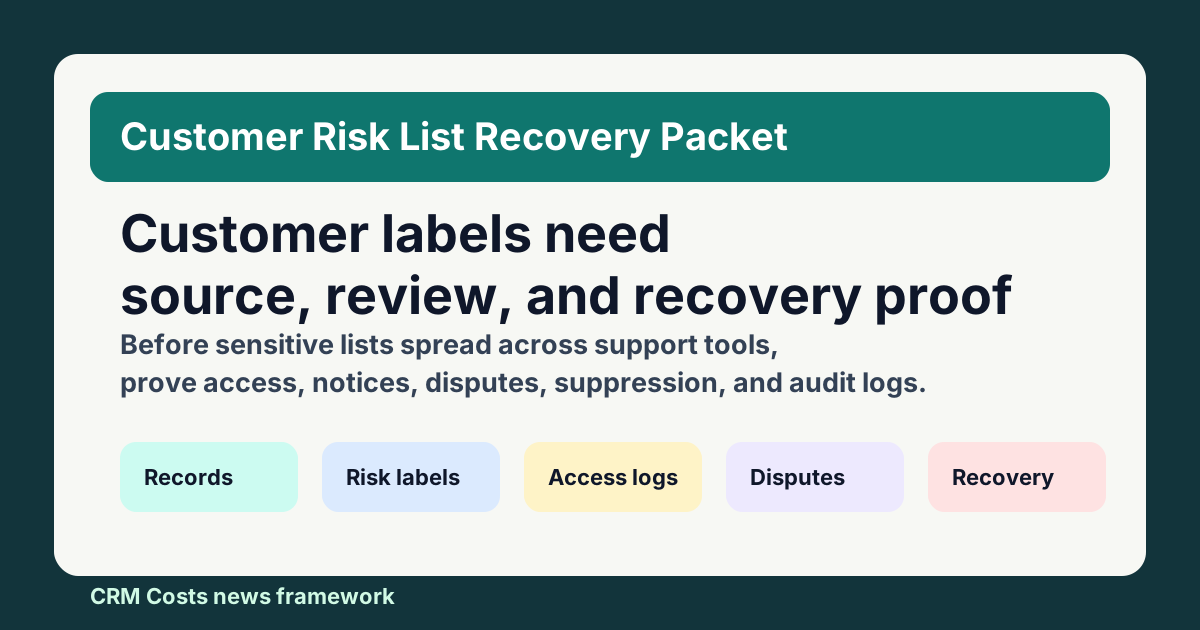
Customer Risk List Recovery Packet
A buyer framework for validating internal customer lists across record scope, access labels, sensitive fields, notices, dispute handling, suppression, and recovery evidence.
Build a record inventory with system, owner, purpose, fields, retention rule, export location, and vendor access.
Require label definitions, allowed users, reason codes, approval thresholds, review cadence, and deletion rules.
Remove unnecessary fields, mask restricted data, set retention timers, and log all access to sensitive notes.
Limit roles, disable stale accounts, review connected apps, log exports, and preserve vendor-access evidence.
Create notice scripts, privacy intake, source lookup, suppression path, correction owner, and customer callback rule.
Track affected records, actions taken, deleted fields, updated labels, notified parties, vendor confirmations, and QA samples.
What buyers should do next
Buyer FAQs
Is the MSG ShinyHunters story only a cybersecurity issue?
No. It is also a support-ops issue because customer records, risk labels, CRM exports, and sensitive notes shape how people are served, escalated, disputed, or excluded.
What should support leaders check after a customer-data leak?
Check record scope, field sensitivity, labels, access roles, connected apps, exports, customer notices, privacy requests, dispute handling, suppression, and vendor-copy deletion.
Why are customer-risk labels risky?
A label can quietly change service treatment. Without reason codes, review dates, access logs, and dispute paths, a stale or biased label can create customer harm and become hard to correct.