

Direct answer
monday AI Work Platform restructuring CRM cost control map: what CRM buyers should take from it
monday.com's July 22, 2026 Form 6-K says the company initiated a restructuring plan aligned with its AI Work Platform strategy and will reduce approximately 20% of its workforce. The filing estimates $45-$55 million in net charges, says monday.com will keep hiring in key strategic areas, and raises FY26 non-GAAP operating margin guidance from about 13% to about 15% while maintaining 19%-20% revenue-growth guidance. CRM and support buyers should not read that as proof that AI automatically lowers operating cost. They should require an AI Work Platform Cost-Control Map showing what work is automated, what human work remains, how AI usage spend is tracked, which workflows are covered, how data is governed, and how customer risk is monitored.
Published 7/23/2026. News event: 7/22/2026.
What happened
- monday.com filed a Form 6-K on July 22, 2026 announcing a restructuring plan aligned with its strategic focus on the AI Work Platform.
- The filing says the plan includes a reduction of approximately 20% of the company's current workforce.
- monday.com expects to continue hiring in key strategic areas throughout 2026.
- The company estimates $45-$55 million in net charges, including severance and employee-benefit costs plus office-space impairment, partially offset by non-cash share-based compensation credits.
- The filing keeps FY26 revenue-growth guidance at 19%-20% and raises non-GAAP operating margin guidance from about 13% to about 15%.
- Business Insider reported that monday.com described the move as part of an AI-driven growth strategy and a shift toward more autonomous teams.
Why this is trending
- The filing links AI strategy, workforce reduction, continued strategic hiring, and higher margin guidance in one clear public disclosure.
- CRM and work-management buyers are being asked to believe that AI Work Platform investment can replace or compress operating work without degrading workflows.
- The story lands in the same renewal debate as AI-assisted internal tools, agentic workflows, and SaaS consolidation: which human tasks remain, which subscription costs remain, and which risks are simply moved into operations.
- Support and RevOps teams need a way to separate real automation economics from shifted admin, QA, data cleanup, and customer recovery costs.
The CRM Costs take
A CRM buyer should use monday.com's filing as a cost-control diligence prompt, not as a product endorsement or a layoff template. The buyer needs an AI Work Platform Cost-Control Map: automation assumptions, retained-human work, workflow coverage, AI usage spend, admin and data-governance load, support fallback, customer-impact monitoring, and a renewal model that shows where cost truly leaves the system.
AI Work Platform Cost-Control Map
A CRM and support-ops buyer framework for validating AI Work Platform economics across automation savings, retained human work, workflow coverage, AI usage spend, data controls, admin load, and customer-risk monitoring.
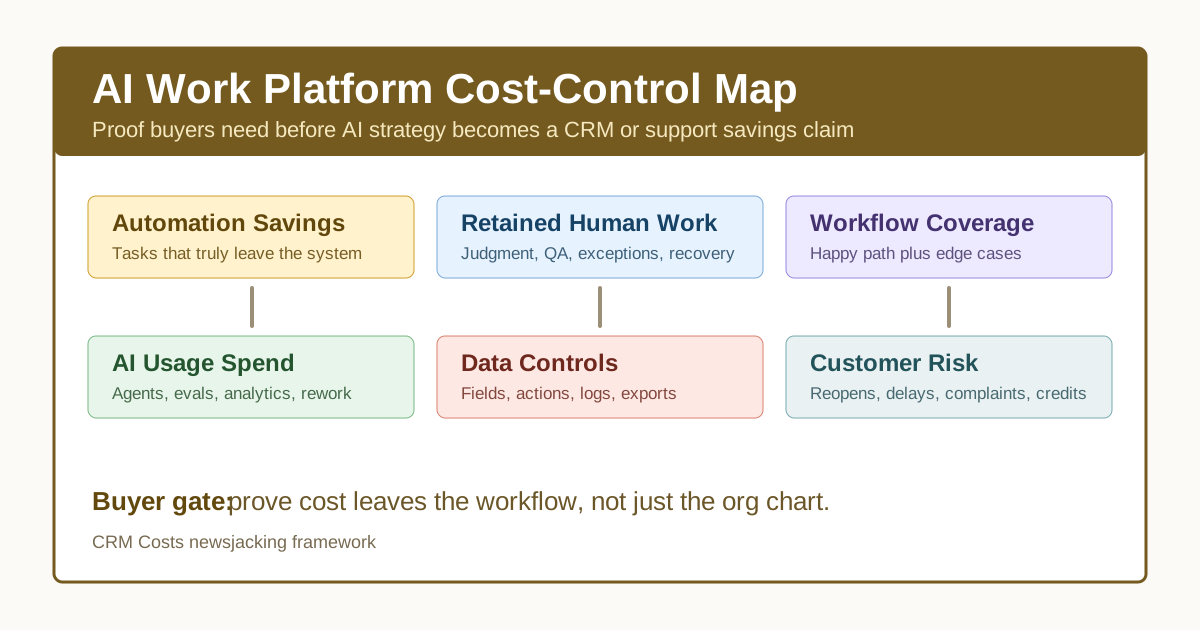
Build a task inventory with baseline volume, current owner, AI replacement assumption, exception rate, and retained-human review rule.
Track retained work by role, weekly hours, skill level, escalation path, and manager owner before reducing coverage.
Create a workflow matrix with acceptance tests, data requirements, integrations, edge cases, rollback, and fallback owner.
Track AI spend by workflow, user, agent, environment, evaluation run, failed attempt, and customer-impacting action.
Map field-level access, board permissions, action scopes, audit logs, retention, exports, and approval requirements.
Add weekly monitoring for reopens, overdue tasks, missed SLAs, escalations, cancellations, credits, complaints, and manual recovery.
What buyers should do next
Buyer FAQs
What did monday.com disclose on July 22, 2026?
monday.com filed a Form 6-K saying it initiated a restructuring plan aligned with its AI Work Platform strategy, including a reduction of approximately 20% of its workforce.
Did monday.com say the cuts lower its margin guidance?
No. The filing keeps FY26 revenue-growth guidance at 19%-20% and raises non-GAAP operating margin guidance from about 13% to about 15%, while estimating $45-$55 million in net restructuring charges.
What should CRM and support buyers learn from the story?
Treat AI Work Platform economics as a proof exercise. Require task-level savings, retained-human work, workflow coverage, AI usage spend, data controls, admin load, and customer-risk monitoring.