

Direct answer
Microsoft 365 Outlook Teams Copilot outage November 12 2026: what CRM buyers should take from it
On November 12, Microsoft reported a multi-service Microsoft 365 disruption affecting Outlook, Teams, SharePoint, Copilot and other services. AP, Reuters and BleepingComputer independently reported widespread user impact. For a support operation, the immediate question is not whether a particular suite is unreliable: it is whether customers can still find a working channel, agents can still see the necessary case record, and an accountable owner can publish a factual update. This scorecard is an illustrative resilience test, not a finding about Microsoft or a guarantee that a secondary service will remain available.
Published 11/13/2026. News event: 11/12/2026.
What happened
- Microsoft’s public status communications described a service degradation and work to reduce impact across multiple Microsoft 365 services.
- Independent reporting described a disruption lasting hours for some users and affecting Outlook, Teams, Copilot and related enterprise services.
- A support team that relies on the same suite for inbound email, collaboration, knowledge access and incident updates can lose several dependencies at once.
- The event creates a useful buyer test: rehearse service continuity with fictional cases and document what remains reachable, who approves messaging and how the normal record is reconciled afterward.
Why this is trending
- The November 12 disruption was broad enough to affect common customer and internal support channels at the same time.
- Independent outlets reported the incident while Microsoft issued public status updates, supplying both primary and independent evidence.
- The buyer lesson is operational rather than vendor-specific: continuity depends on tested channels, evidence capture and ownership, not a generic promise of high availability.
The CRM Costs take
Treat the scorecard as a tabletop exercise. Use fictional cases and approved test accounts. Ask a vendor or internal owner to demonstrate how a customer finds a status update, how an agent accepts a request without the normal inbox, how the team protects promised-response times, and how temporary records return to the controlled system. Do not copy customer data into unapproved tools or assume a consumer messaging channel satisfies privacy, retention or accessibility obligations.
Support-Channel Failover Scorecard
An original six-part buyer scorecard for testing customer communications, case evidence and escalation ownership during a productivity-suite outage.
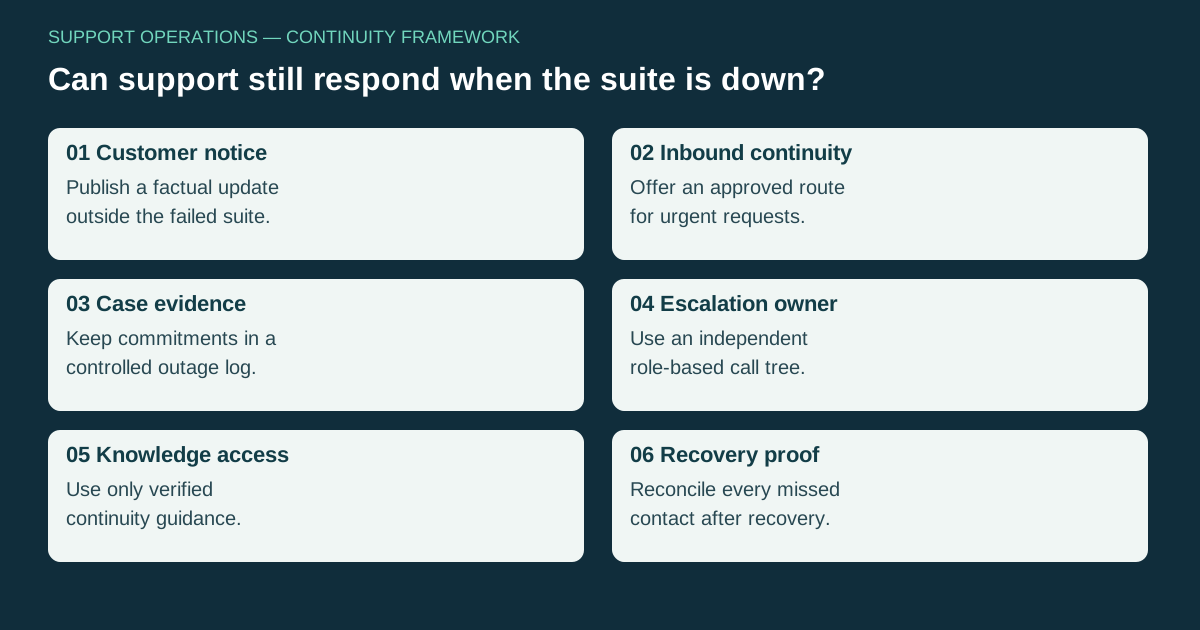
Name an independently hosted status path, update owner, review cadence and accessible holding message.
Publish approved fallback channels, capacity limits, identity checks and a safe message for non-urgent requests.
Use a controlled outage log with case reference, owner, promise and reconciliation deadline.
Document a role-based call tree and at least one independent contact route.
Keep a short approved continuity pack with service boundaries, escalation criteria and version owner.
Reconcile the temporary log, notify affected customers where appropriate and retain a short post-incident record.
What buyers should do next
Buyer FAQs
Did the Microsoft 365 outage prove that every support team needs a second productivity suite?
No. A secondary suite has cost, security and operating trade-offs. The event supports testing required outcomes and dependencies, not a universal architecture decision.
What should a support team test first?
Test whether a customer can find an approved update, whether an agent can accept an urgent request safely, and whether a named owner can preserve and reconcile the resulting commitment.
Can a personal messaging account be an outage fallback?
Not by default. The appropriate fallback depends on authorization, identity verification, privacy, retention, accessibility and local obligations. Use approved channels and qualified owners.
Does this article identify the outage cause?
No. It uses the published incident as a continuity case study and does not infer a technical root cause beyond the cited status updates and reporting.