

Direct answer
HubSpot data enrichment reversal customer backlash opt-in CRM data governance July 2026: what CRM buyers should take from it
HubSpot reversed planned July 2026 terms-of-service changes after customer backlash over enrichment-data sharing. HubSpot's community post said it would not move forward with the July 1 changes and that future enrichment capabilities using customer data would be fully and transparently opt-in. CRM buyers should treat the episode as a governance test: know who can opt in, which fields are in scope, which data feeds vendor tools, and how to prove customer data has not drifted into a use the business did not approve.
Published 7/9/2026. News event: 7/7/2026.
What happened
- HubSpot posted a July 5 community update saying it made a mistake and would not move forward with terms-of-service changes communicated on July 1, 2026.
- The post said customer CRM data belongs to customers and should not be used without permission or in unexpected ways.
- CMSWire reported that the reversed plan involved data discovery and intelligence features and enrichment data such as business contact details, employer information, and email deliverability signals.
- CX Today and MarTech independently covered the reversal and customer backlash, framing the episode as a trust and customer-data-control issue.
- HubSpot's knowledge base still describes data enrichment as using HubSpot's commercial dataset, which means buyers still need to govern enrichment settings, opt-out notices, and connected data flows.
Why this is trending
- The story spread because CRM customers saw a vendor-policy change as a customer-data-control issue, not a normal product update.
- AI and enrichment features increasingly blur the boundary between a customer's operational records and a vendor's broader commercial dataset.
- Support and RevOps teams often store call recordings, notes, deals, tickets, custom fields, email engagement, and lifecycle data in the same CRM, which makes data-use consent more operational than legal boilerplate.
The CRM Costs take
A CRM or support-ops buyer should not assume data governance is solved because a vendor says customers own their data. The buyer needs a control map: who can opt in, which fields can contribute to enrichment, how AI model training differs from enrichment sharing, which connected apps can export data, how opt-outs are honored, and who can roll back a setting after a policy change.
CRM Data Governance Control Map
A buyer framework for validating enrichment, AI training, connected apps, export rights, field scope, opt-in authority, audit logs, and rollback ownership before CRM data leaves the workflow boundary.
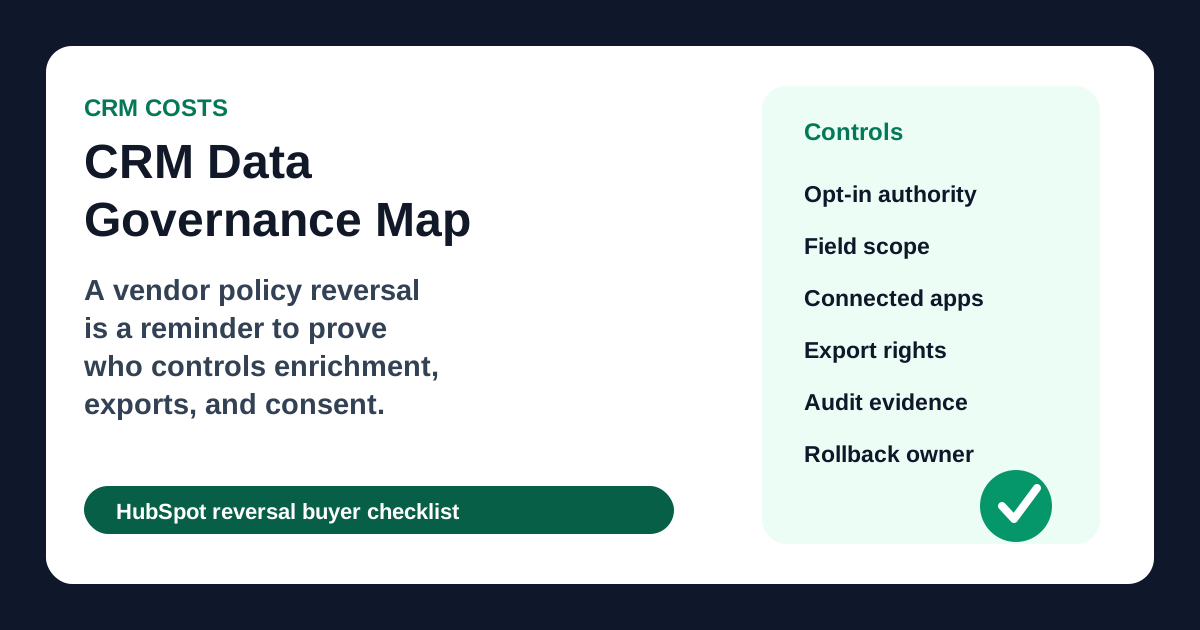
Create an approval register for enrichment, AI, beta, and data-sharing settings with named business, security, and operations owners.
Export a field-scope map with sensitive fields, allowed enrichment fields, blocked fields, retention rules, and owner signoff.
Document each data-use path separately, including setting location, default state, opt-in or opt-out status, evidence, and rollback owner.
Review connected apps, API tokens, export permissions, outsourced-user roles, report subscriptions, and stale admin accounts.
Capture screenshots, audit logs, admin setting exports, DPA changes, internal approvals, and customer-notice decisions.
What buyers should do next
Buyer FAQs
Did HubSpot move forward with the July 2026 terms changes?
No. HubSpot's July 5 community post said it would not move forward with the July 1 terms-of-service changes and committed that future enrichment capabilities using customer data would be fully and transparently opt-in.
Why does this matter outside HubSpot?
The same governance issue appears across CRM, helpdesk, enrichment, AI, RevOps, and outsourced-support tools. Buyers need to know which data leaves the operational workflow and who approved that use.
What should a CRM buyer check before enabling enrichment or AI data features?
Check opt-in authority, field scope, AI training settings, enrichment dataset participation, connected apps, export rights, audit logs, opt-out handling, data-processing terms, outsourced-agent access, and rollback ownership.