

Direct answer
Grant Thornton AI proof gap 78 percent governance audit CRM support AI: what CRM buyers should take from it
Grant Thornton's 2026 AI Impact Survey found that 78% of surveyed business executives lack strong confidence that their organization could pass an independent AI governance audit within 90 days. Current agentic AI governance coverage is resurfacing the same problem: companies are deploying AI faster than they can prove accountability. CRM and support operations buyers should require a proof-gap scorecard before scaling AI in tickets, records, summaries, routing, or customer workflows.
Published 7/4/2026. News event: 7/3/2026.
What happened
- Grant Thornton's 2026 AI Impact Survey reported that 78% of executives lack strong confidence they could pass an independent AI governance audit within 90 days.
- The same report said organizations with fully integrated AI are nearly four times more likely to report AI-driven revenue growth than those still piloting, 58% versus 15%.
- Grant Thornton's recent midmarket AI governance article said governance, strategy, and operational-control gaps are limiting measurable returns despite strong AI momentum.
- TechRadar Pro's current agentic AI governance coverage warned that adoption in regulated workflows can outrun governance, validation skills, workflow design, and cross-functional oversight.
- Gartner's 2026 customer-service survey found 91% of service leaders under pressure to implement AI, which explains why support teams may scale tools before evidence catches up.
Why this is trending
- AI governance is moving from board-policy language into day-to-day CRM and support operations because AI now drafts replies, summarizes cases, changes records, routes work, and triggers follow-up.
- The 78% audit-confidence figure gives executives a hard number for a problem many support leaders already see: nobody can easily prove who owns an AI-assisted decision when a customer outcome goes wrong.
- Agentic AI raises the stakes because tool-calling systems can touch CRM records, ticket status, refunds, callbacks, knowledge bases, and customer messages without the clean boundaries older automations had.
The CRM Costs take
A CRM buyer should not approve support AI by looking only at containment, handle-time reduction, or demo accuracy. The buyer needs a proof-gap scorecard: which record is authoritative, who owns each decision, which logs are retained, which guardrails block risky actions, how failures roll back, and what customer outcome proves the workflow is safe to scale.
CRM AI Proof Gap Scorecard
A buyer framework for scoring support AI and CRM automation readiness across source-of-truth records, decision ownership, audit logs, guardrails, rollback, QA, and outcome proof.
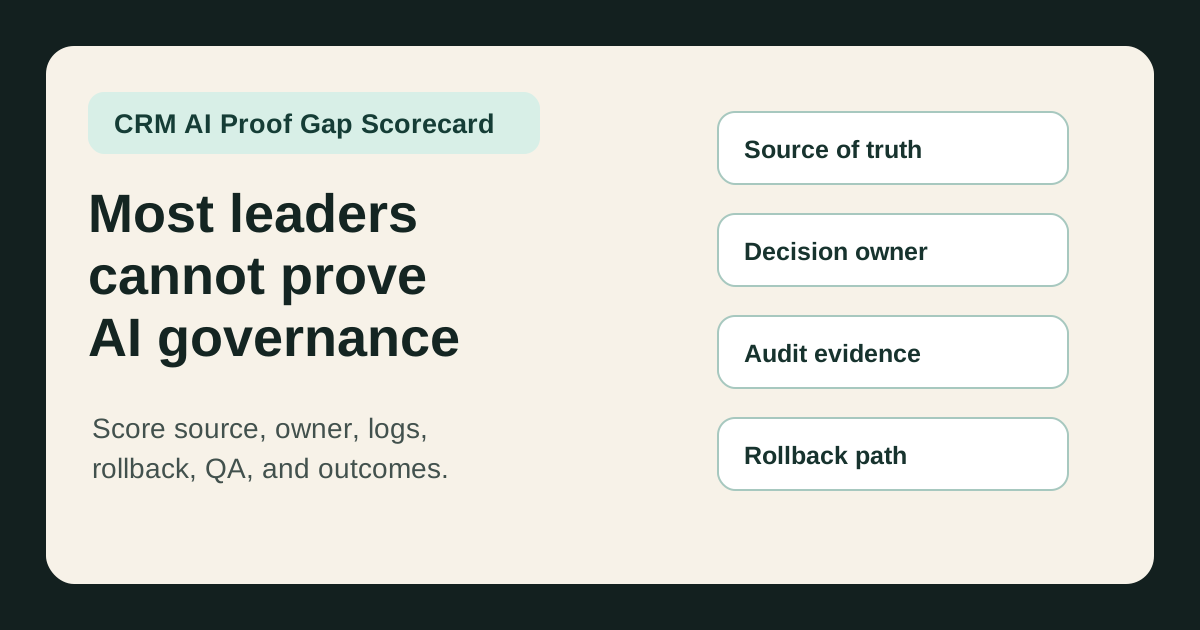
Define approved sources, record precedence, update owners, stale-data rules, and QA samples before expanding AI access.
Assign named owners for each AI-assisted workflow, with approval thresholds and blocked actions.
Retain prompt/tool logs, source references, record-change history, release notes, QA decisions, and supervisor corrections.
Document allowed actions, blocked topics, approval gates, rollback triggers, and customer-repair steps.
Compare baseline and AI-assisted workflows on resolution quality, reopens, repeat contact, QA misses, cost, and customer recovery.
What buyers should do next
Buyer FAQs
What is the AI proof gap?
Grant Thornton uses the phrase to describe the disconnect between AI investment and accountability. In its 2026 survey, 78% of executives lacked strong confidence they could pass an independent AI governance audit within 90 days.
Why does this matter to support operations?
Support AI often touches customer records, case summaries, routing, replies, callbacks, refunds, bookings, and escalations. If teams cannot prove source, owner, action, log, and rollback, a small automation error can become a customer-recovery and compliance problem.
What should CRM buyers ask vendors for first?
Ask for source-of-truth controls, decision ownership, audit logs, action limits, human approval gates, rollback procedures, QA sampling, and outcome evidence beyond containment.