

Direct answer
Google OSS VRP paused AI generated vulnerability reports automated submissions October 2026: what CRM buyers should take from it
TechCrunch reported on October 4 that Google paused its Open Source Software Vulnerability Rewards Program until next year after a significant rise in AI-generated submissions. ITPro said the pause took effect on October 1 for product vulnerabilities while supply-chain compromise reports remained in scope. The Cloud Security Alliance's October 9 research note framed the underlying cost problem: AI lowers the cost of producing plausible vulnerability reports, while verification still depends on scarce human triage. Support and security-operations buyers should treat this as an intake-cost warning for any AI-assisted report queue, not only bug bounty programs.
Published 10/11/2026. News event: 10/4/2026.
What happened
- TechCrunch reported that Google froze the open-source bug bounty program after a significant rise in AI-generated submissions.
- ITPro reported that the program stopped accepting OSS product vulnerabilities as of October 1, with a planned pause until Q1 2027 and supply-chain compromise reports still accepted.
- The Cloud Security Alliance said automated submissions can look plausible while leaving the verification burden with human maintainers and triagers.
- The same pattern can affect support queues when AI-generated bug reports, compliance tickets, security findings or customer complaints arrive faster than evidence can be checked.
Why this is trending
- The story connects AI-generated content to a concrete operational cost: validating reports that may be invalid, duplicate, low-context or unsupported by reproduction steps.
- Security teams, support desks and open-source maintainers increasingly share the same intake problem when AI tools create high-volume, plausible-looking submissions.
- This is distinct from generic AI slop commentary because the buyer evidence sits in queue design, proof requirements, accountability and reward or escalation rules.
The CRM Costs take
An illustrative support organization may accept AI-assisted bug reports, partner tickets, QA findings, vendor alerts or compliance claims. If the intake form rewards volume and plausible wording, the team can spend expensive reviewer time on reports that lack reproduction, ownership or impact. Buyers should require a triage map before expanding AI report channels: what evidence is mandatory, what duplicates are suppressed, who stands behind the report, when humans review, and when a queue is paused. This framework is a planning aid, not a finding about Google's internal program controls or legal obligations.
AI Report Triage Cost Map
An original support-operations map for intake scope, reproducible evidence, duplicate handling, human accountability, reward fit and maintainer feedback.
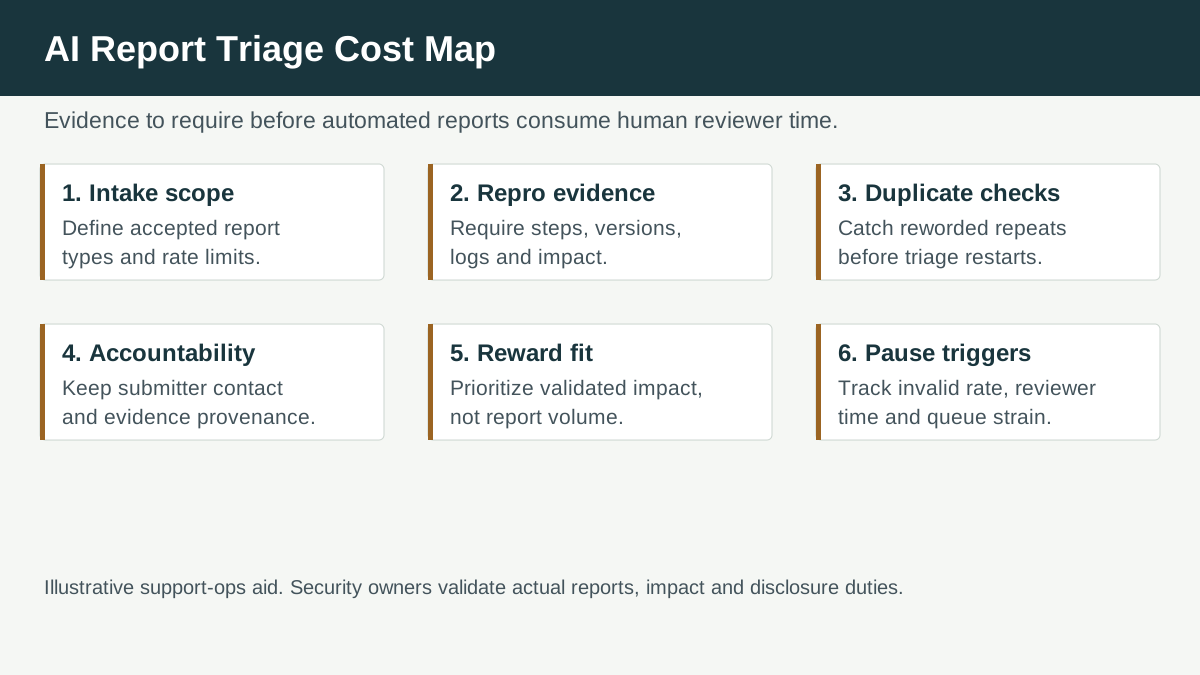
Define accepted categories, excluded categories, rate limits, required fields and pause criteria before opening the channel.
Require reproduction fields and reject or park reports that cannot be independently verified.
Use canonical issue IDs, similarity search, maintainer notes and duplicate-resolution templates.
Require submitter attestation, contactability, evidence provenance and response windows.
Tie bounty, SLA or escalation priority to validated impact, completeness and novelty.
Track invalid rate, duplicate rate, time to reproduce, pause triggers and maintainer workload.
What buyers should do next
Buyer FAQs
Did Google shut down all vulnerability reporting?
No. The reviewed coverage says the open-source VRP pause applied to OSS product vulnerabilities, while supply-chain compromise reports remained accepted.
Does this mean AI-generated reports are always useless?
No. The risk is not the tool alone. It is a queue that accepts plausible reports without reproducible evidence, accountable follow-up or duplicate control.
Why does this matter to support operations?
Support desks also receive bug reports, security claims, partner escalations and compliance tickets. AI can increase volume faster than humans can verify quality.
Can automation solve the triage flood by itself?
Automation can help route and deduplicate, but final impact and remediation decisions still need accountable human review and reproducible evidence.