

Direct answer
Genesys 2026 State of CX AI customer service readiness proof: what CRM buyers should take from it
Genesys published its 2026 State of Customer Experience report in July 2026, based on surveys of 5,811 consumers and 1,560 CX and business leaders. Genesys says 76% of consumers expect AI to improve service speed and quality, 84% will give a virtual agent up to three attempts to resolve an issue, and 47% would consider switching after two or three poor interactions. Support-ops buyers should treat the report as an AI service-readiness proof trigger: validate data foundations, virtual-agent limits, human escalation, QA, and outcome evidence before promising AI-led service improvements.
Published 7/17/2026. News event: 7/14/2026.
What happened
- Genesys published its 2026 State of Customer Experience report in July 2026.
- The report is based on 5,811 consumers and 1,560 CX and business leaders across global markets.
- Genesys says 76% of consumers expect AI to improve speed and quality in customer service.
- Genesys also says 84% of consumers will give a virtual agent up to three attempts before expecting resolution or escalation.
- CX Today independently covered the report and highlighted rising expectations, including that many customers judge a company by its service quality.
Why this is trending
- The report gives support leaders a fresh benchmark for a reality they already feel: customers expect AI convenience without tolerating broken automation loops.
- Genesys says 40% of CX organizations are already using agentic AI, while 82% of CX leaders expect autonomous agents to orchestrate CX within three years.
- The same report points to readiness constraints: leaders cite AI innovation speed and data-management challenges, and only a minority say their CX infrastructure is fully cloud-based.
The CRM Costs take
A support-ops buyer should not accept an AI service promise without readiness proof. The buyer needs an AI Service Readiness Proof Map: customer patience threshold, virtual-agent attempt limit, agentic AI ownership, data and cloud readiness, human escalation, QA sample, and outcome report that shows containment beside reopens, complaints, and switching risk.
AI Service Readiness Proof Map
A buyer framework for validating AI customer-service readiness across customer patience, virtual-agent attempts, agentic orchestration, data foundations, human escalation, and outcome reporting.
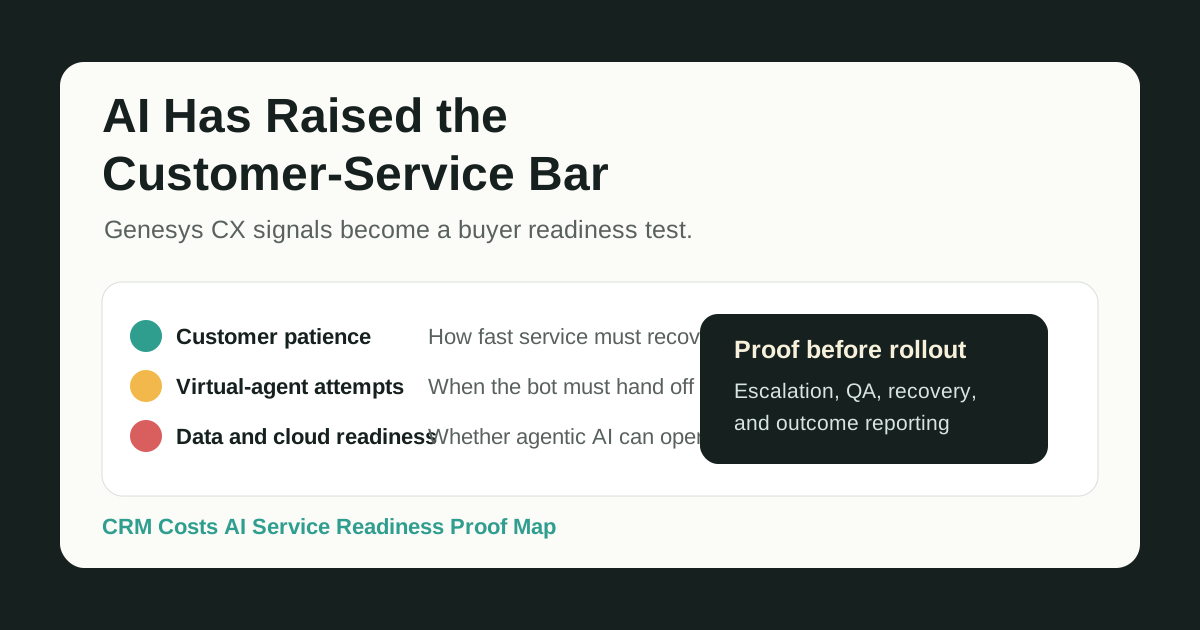
Define patience thresholds, repeat-contact triggers, complaint tags, churn watchlists, and recovery ownership by queue.
Set attempt limits, confidence thresholds, urgent-intent triggers, handoff wording, and context-transfer evidence.
Document tool permissions, approval gates, model actions, change logs, rollback triggers, and human owner for each workflow.
Audit record quality, knowledge sources, integration permissions, cloud dependencies, retention rules, and data owners.
Protect escalation rosters, supervisor routes, callback SLAs, training samples, language coverage, and recovery reporting.
Report containment, speed, transfers, reopens, complaints, manual fixes, callbacks, QA defects, and retained staffing together.
What buyers should do next
Buyer FAQs
What did Genesys report?
Genesys' 2026 State of Customer Experience report says consumers increasingly expect AI to improve service speed and quality, while still requiring reliable escalation and human service when automation does not resolve the issue.
Why should support-ops buyers care?
The report turns AI service expectations into an operating proof problem. Buyers need evidence that virtual agents, agentic AI, CRM data, humans, and reporting can support real customer outcomes.
What proof should buyers ask for?
Ask for customer patience thresholds, virtual-agent attempt limits, tool permissions, data-readiness audit, human escalation roster, QA samples, and weekly outcome reporting that includes reopens, complaints, transfers, callbacks, and manual fixes.