

Direct answer
Gartner third-party GenAI company chatbots customer service risk map: what CRM buyers should take from it
Gartner said on July 8, 2026 that customers are approximately three times more likely to use third-party GenAI tools than company-provided chatbots for customer service. Gartner's survey covered 3,566 B2B and B2C customers in February and March 2026 and found third-party GenAI use has nearly doubled while company chatbot use has not statistically increased since 2022. CX Dive independently covered the finding and quoted Gartner's warning that GenAI is shifting interactions outside company-owned channels. Support-ops buyers should respond by proving whether their knowledge, chatbot, human escalation, feedback capture, and recovery reporting can correct what outside AI tells customers.
Published 7/20/2026. News event: 7/8/2026.
What happened
- Gartner published the survey finding on July 8, 2026.
- The survey included 3,566 B2B and B2C customers between February and March 2026.
- Gartner said customers are about three times more likely to use third-party GenAI tools than company-provided chatbots for customer service.
- Gartner said third-party GenAI use has nearly doubled while company chatbot use has not statistically increased since 2022.
- CX Dive independently covered the finding and reported that many brands have invested in chatbots even as customers increasingly rely on outside AI tools.
Why this is trending
- The finding challenges a common AI support assumption: deploying a company chatbot does not mean customers will use it first.
- Customers increasingly ask general GenAI tools to interpret policies, compare products, summarize returns, troubleshoot accounts, and decide whether to contact support.
- That creates a support-ops risk because outside AI may use stale, incomplete, or scraped information while the company still owns the complaint, return, chargeback, or lost customer.
The CRM Costs take
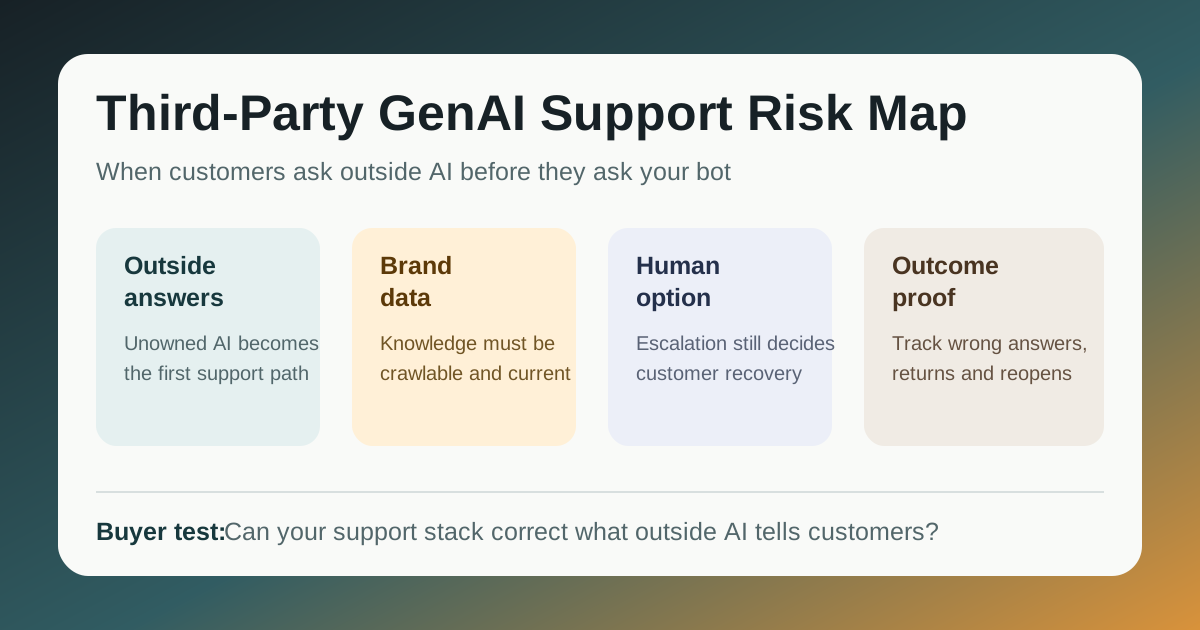
A support-ops buyer should not measure AI service only inside the brand chatbot. The buyer needs a Third-Party GenAI Support Risk Map: crawlable and current knowledge, source-of-truth pages, chatbot limit tests, human escalation, feedback capture for wrong outside answers, and recovery reporting that shows how support corrects misinformation customers bring in.
Third-Party GenAI Support Risk Map
A support-ops buyer framework for auditing customer answers that happen outside company-owned channels across knowledge freshness, chatbot limits, escalation, feedback capture, and recovery evidence.
Run recurring outside-AI answer checks for top service intents, product questions, refunds, cancellation, warranties, and account issues.
Publish clear source-of-truth pages with updated dates, canonical URLs, structured FAQs, policy boundaries, and escalation links.
Test top customer intents across the company chatbot, search, help center, phone, email, chat, and third-party GenAI tools.
Define wrong-answer escalation triggers, context intake, callback rules, refund or correction authority, and visible human-contact paths.
Add tags for outside AI, stale page, chatbot loop, wrong policy, bad summary, and missing source-of-truth page.
Report outside-answer defects beside reopens, refunds, complaints, contacts by channel, lost revenue, and source-page fixes.
What buyers should do next
Buyer FAQs
What did Gartner report about GenAI and service chatbots?
Gartner reported that customers are approximately three times more likely to use third-party GenAI tools than company-provided chatbots for customer service, based on a 2026 survey of 3,566 B2B and B2C customers.
Why does this matter to support operations?
Customers may arrive with answers from outside AI tools before they ever use the company's chatbot. Support teams still have to correct stale, incomplete, or wrong advice and recover the customer experience.
What proof should buyers ask for?
Ask for outside-AI answer checks, current source-of-truth pages, structured FAQs, chatbot comparison tests, human-escalation triggers, agent defect tags, and recovery reporting for reopens, refunds, complaints, and lost customers.