

Direct answer
Gartner 234 billion enterprise application SaaS spend at risk agentic AI arbitrage July 2026: what CRM buyers should take from it
Gartner said on July 1, 2026 that up to $234 billion in enterprise application software spend is exposed to agentic AI arbitrage by 2030, equal to roughly 20% of enterprise application SaaS spend. Gartner's point is not that SaaS disappears tomorrow. It is that agentic AI can change the economics of workflow-heavy, user-experience-heavy software. Support-ops buyers should respond by mapping which SaaS seats, workflows, add-ons, AI agents, and human recovery tasks are actually needed before renewals expand.
Published 7/14/2026. News event: 7/1/2026.
What happened
- Gartner's July 1, 2026 release says up to $234 billion in enterprise application software spend is exposed to agentic AI arbitrage by 2030.
- The same release says that exposure equals about 20% of enterprise application SaaS spend.
- Gartner defines the risk around agentic AI's ability to arbitrage software spend where applications are heavily workflow-driven or user-experience-driven.
- Market coverage around enterprise software has also focused on how AI agents could change spending expectations for companies such as Salesforce, ServiceNow, and other SaaS vendors.
- For support teams, the operating issue is whether CRM and helpdesk spend still maps to real work, clean data, human owners, measurable outcomes, and recoverable customer workflows.
Why this is trending
- The $234 billion figure gives buyers and CFOs a concrete number for a debate that has been mostly abstract: how much SaaS value can agentic AI replace, compress, or rebundle?
- CRM, helpdesk, RevOps, back-office, and customer support teams are already being asked to fund AI copilots and agents on top of existing subscriptions.
- If buyers add AI tools without retiring duplicate workflows or proving human recovery, SaaS savings can turn into more admin work, more cleanup, and more renewal pressure.
The CRM Costs take
A support-ops buyer should not approve an AI-agent add-on or a SaaS renewal by comparing license lines alone. The buyer needs an Agentic SaaS Spend Risk Map: workflow owner, system of record, data quality, tool permissions, AI substitution target, retained human work, escalation path, reporting proof, and renewal economics.
Agentic SaaS Spend Risk Map
A buyer framework for validating SaaS and AI-agent spend across workflow ownership, data readiness, tool scope, substitution risk, human recovery, and renewal economics.
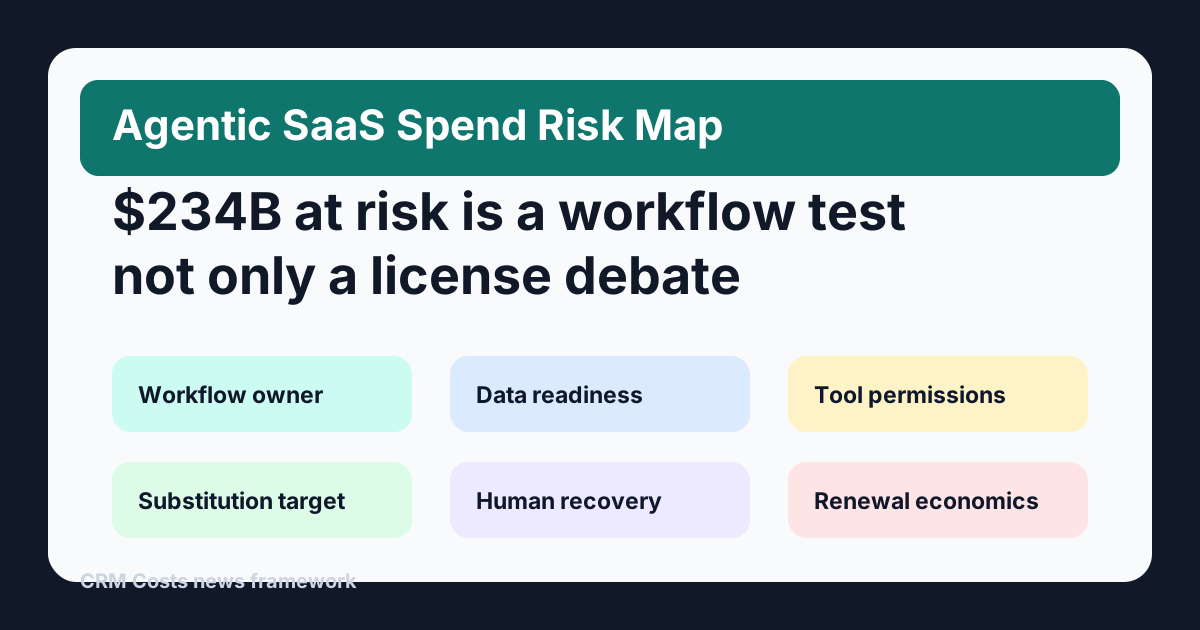
Write a workflow owner map for every AI-assisted action, including approval, escalation, rollback, and customer callback.
Audit a production sample for duplicate records, missing required fields, stale records, sensitive data, and broken integrations.
Document allowed tools, blocked actions, approval thresholds, audit logs, and rollback rules by workflow.
Tie each AI workflow to a named spend line, retained work estimate, decommission candidate, or measurable service improvement.
Track failed AI sessions, reopens, escalations, manual fixes, callbacks, customer complaints, and final recovery owner.
Model software seats, AI usage, integration services, cleanup work, admin time, QA time, retained staff, and renewal uplift together.
What buyers should do next
Buyer FAQs
Did Gartner say SaaS is going away?
No. Gartner said up to $234 billion in enterprise application SaaS spend is exposed to agentic AI arbitrage by 2030. Buyers should read that as a spend and workflow diligence signal, not a claim that all SaaS disappears.
What is the support-ops risk?
The risk is paying for SaaS, AI agents, implementation, cleanup, QA, and retained human work at the same time because the buyer never mapped which workflow or spend line AI is supposed to change.
What should CRM and support buyers ask for?
Ask for workflow ownership, production-data readiness, tool-permission scope, substitution target, human recovery plan, audit logs, total-cost model, and renewal impact before scaling AI-agent spend.