

Direct answer
Curative Salesforce CRM cancellation AI build cost risk map: what CRM buyers should take from it
Business Insider reported on July 21, 2026 that Curative CEO Fred Turner said the company canceled a $600,000-a-year Salesforce CRM contract after building an internal CRM in two months with AI-assisted coding. Business Insider said Curative confirmed it notified Salesforce of the cancellation, and a 20VC transcript summary separately recorded Turner saying the internal build replaced Salesforce at that annual cost level. CRM buyers should not read the story as a blanket instruction to replace Salesforce. They should use it as a cost-risk test: prove net savings, AI usage spend, maintenance load, data controls, workflow coverage, user support, and fallback before replacing a system of record.
Published 7/22/2026. News event: 7/21/2026.
What happened
- Business Insider reported on July 21, 2026 that Curative CEO Fred Turner said the health insurance company canceled a $600,000-a-year Salesforce CRM contract after building an internal CRM.
- The article said Turner described the CRM as built in two months with AI-assisted coding and said Curative plans to cut about 80% of SaaS spending this year while spending more on AI.
- Business Insider reported that a Curative spokesperson confirmed the cancellation notification and that Salesforce pointed to its 150,000 customers plus trust and governance in regulated industries.
- A 20VC transcript summary also recorded Turner describing the Salesforce replacement, the $600,000 annual contract, and the internal CRM build.
- Turner also acknowledged that maintaining the internally built systems is challenging, which is the buyer-risk detail behind the savings headline.
Why this is trending
- The story lands directly in the current executive question: which SaaS subscriptions are still worth the renewal when AI-assisted internal tools are cheaper to build?
- CRM is a system of record, not a side app, so a replacement claim forces buyers to examine workflow coverage, audit trails, integrations, user support, and data governance.
- The reported savings headline is concrete, but the maintenance caveat keeps it from being a simple anti-SaaS story.
The CRM Costs take
A CRM buyer should use the Curative story as a build-vs-buy diligence packet. The right question is not 'Can we code a CRM quickly?' It is 'Can we prove lower total cost after AI usage, maintenance, compliance, support, data quality, uptime, integration rebuilds, and exit risk?'
AI-Built CRM Cost Risk Map
A CRM buyer framework for validating subscription replacement across net savings, AI usage spend, maintenance ownership, data controls, workflow coverage, support fallback, and exit evidence.
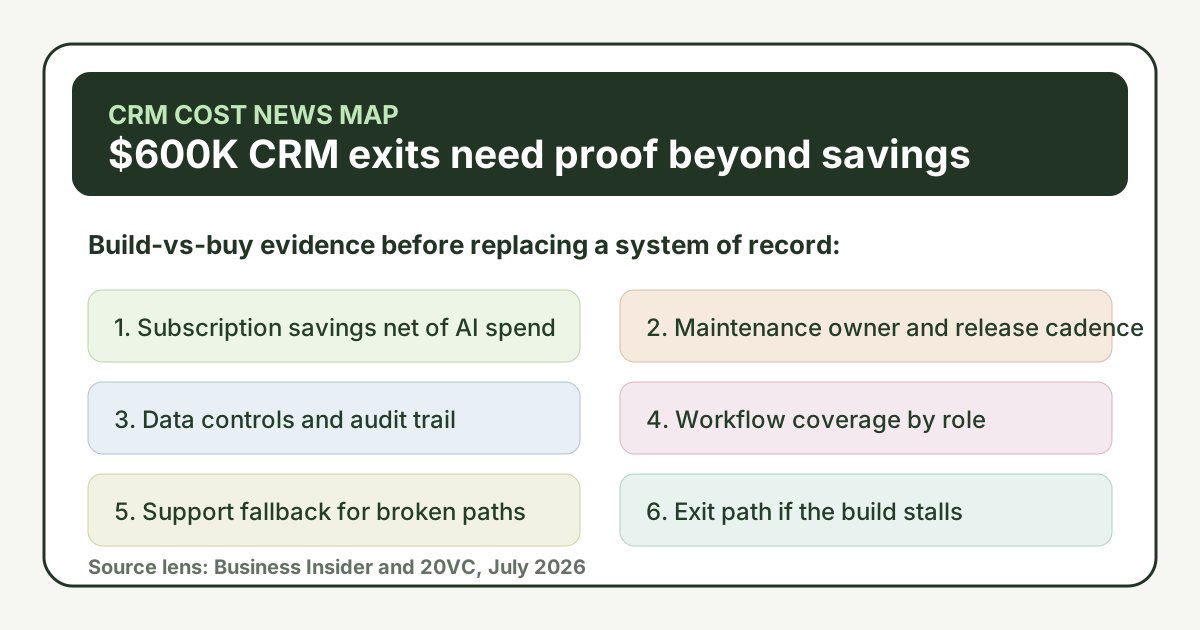
Build a renewal model that nets SaaS savings against AI tokens, infrastructure, engineer time, support load, testing, and incident response.
Track AI spend by build, test, production agent, analytics, support, and rework category before canceling the renewal.
Assign named owners, release windows, backlog rules, QA checks, incident rota, documentation, and rollback paths.
Map every regulated field, role permission, change log, export, data retention rule, and compliance report before migration.
Create a workflow matrix with owner, edge case, integration, report, acceptance test, and fallback for every critical role.
Define support tiers, escalation, training, user documentation, data export, recovery plan, and exit criteria before termination.
What buyers should do next
Buyer FAQs
What did Business Insider report about Curative and Salesforce?
Business Insider reported that Curative CEO Fred Turner said the company canceled a $600,000-a-year Salesforce CRM contract after building an internal CRM in two months with AI-assisted coding.
Does this mean every company should build its own CRM?
No. The buyer lesson is to compare total cost, maintenance, workflow coverage, data controls, support, and fallback before replacing a CRM system of record.
What is the first proof to request in a build-vs-buy review?
Start with a workflow coverage matrix and a total-cost model that includes AI usage, engineering, QA, support, infrastructure, security, and exit risk.