

Direct answer
Claude shared chats indexed support data exposure map: what CRM buyers should take from it
Reports on July 27, 2026 said publicly shared Claude chats and artifacts appeared in Google and Bing search results. The issue did not mean every private Claude conversation was public: Axios reported Claude creations are private by default, while public links created through sharing can become visible to search engines. Wired reported robots.txt blocking alone was not enough without page-level noindex controls. CRM and support buyers should treat the story as a share-link exposure test and require an AI Support Share-Link Exposure Map before teams put tickets, customer records, internal playbooks, or AI-generated support artifacts behind shareable URLs.
Published 7/28/2026. News event: 7/27/2026.
What happened
- Wired reported on July 27, 2026 that Claude shared chats appeared in Google and Bing search results.
- Axios reported that Claude creations are private by default, but public links created for sharing can be visible to search engines.
- Axios also reported Anthropic said it does not provide chat directories or sitemaps to search engines.
- Wired reported Anthropic had used robots.txt to block shared chats, but page-level noindex controls were the missing search-indexing safeguard.
- TechCrunch covered the privacy concern around Claude shared-chat exposure, and Fortune reported that some examples found in search reportedly included sensitive information.
- The buyer-relevant point is not that public sharing is always wrong. It is that support teams need to know which AI workspaces, chatbot transcripts, artifacts, and generated documents can become discoverable.
Why this is trending
- The story tied a familiar support workflow, sharing a link to a generated answer or document, to public search visibility.
- It followed earlier public-chat indexing concerns around other AI tools, making the risk recognizable to executives, security teams, and support leaders.
- Support teams often paste customer facts, internal policy, CRM records, refund notes, screenshots, and escalation context into AI tools, so accidental public links can create real customer-data exposure.
- Independent coverage from Wired, Axios, TechCrunch, Fortune, and other outlets gave the issue enough momentum to treat it as buyer-risk news rather than a niche platform bug.
The CRM Costs take
A CRM or support buyer should not evaluate AI assistants only by answer quality and speed. The buyer needs an AI Support Share-Link Exposure Map: which tools can create public links, whether those pages carry noindex controls, which fields are blocked from prompts and artifacts, how shared links are revoked, which logs prove exposure scope, how long artifacts live, and how customers are notified or remediated if support data becomes searchable.
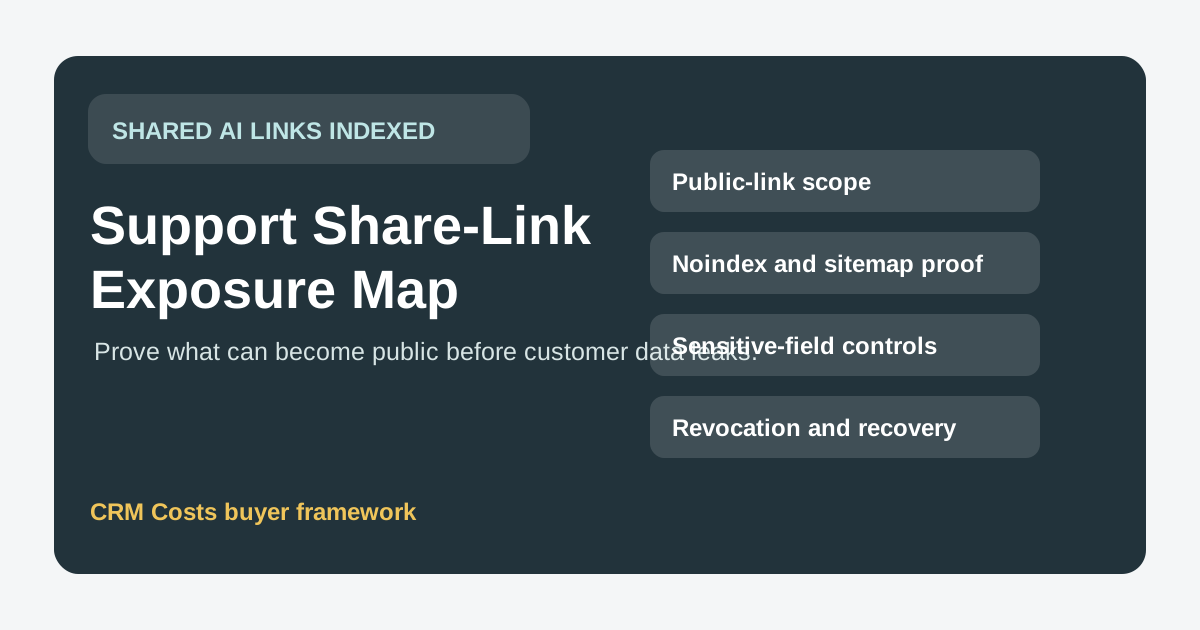
AI Support Share-Link Exposure Map
A support-ops buyer framework for validating AI workspace and chatbot sharing across public-link scope, search-index controls, sensitive-field handling, revocation, logs, retention, and customer remediation.
Inventory every AI share feature, default state, permission role, expiry setting, domain restriction, and external-recipient path.
Ask for a testable indexing-control packet with noindex proof, robots behavior, sitemap policy, cache handling, and search-removal workflow.
Add field labels, prompt filters, attachment rules, redaction checks, DLP review, and blocked-share rules for sensitive support records.
Require admin-visible link inventory, owner records, expiry dates, bulk revoke, emergency disable, and proof that removed pages leave search caches.
Capture share events, viewer metadata where lawful, artifact versions, prompt sources, revocation timestamps, and search-removal evidence.
Write a remediation runbook with exposure classification, legal review, customer notice templates, search deindexing, credit or account controls, and recovery owner.
What buyers should do next
Buyer FAQs
Were all Claude chats made public?
No. Axios reported Claude creations are private by default. The reported exposure concerned chats, artifacts, apps, documents, and tools that users had made public through sharing links.
Why does this matter to support teams?
Support teams can put customer details, ticket context, attachments, internal policies, refunds, and escalation notes into AI tools. If public sharing is poorly controlled, that work can become searchable or externally viewable.
What proof should buyers ask vendors for first?
Ask for public-link inventory, default sharing controls, page-level noindex proof, sitemap exclusion, sensitive-field redaction, admin revocation, audit logs, retention rules, and exposure remediation support.