

Direct answer
CISA AI distillation CRM model provenance risk map: what CRM buyers should take from it
A September 2026 joint advisory from NSA, CISA, FBI and partner agencies warned that several China-based AI companies allegedly used industrial-scale knowledge distillation against U.S. models, including for domains such as customer-service dialogue and end-to-end agentic workflows. AP reported that China pushed back on the advisory and that named companies did not immediately respond. CRM buyers should respond with provenance and monitoring questions, not panic: know which models, accounts, aggregators and agents can touch customer data before AI support savings are counted.
Published 9/10/2026. News event: 9/8/2026.
What happened
- The joint cybersecurity advisory, dated September 2026, says U.S. and allied agencies are warning organizations about alleged industrial-scale knowledge distillation against U.S. AI models.
- The advisory names several China-based AI companies and describes pathways including native APIs, cloud providers, third-party aggregators and transfer stations.
- It says the activity involved billions of tokens and millions of requests since late 2024, targeting premium frontier models through multiple access routes.
- The advisory's table includes customer-service dialogue and end-to-end agentic workflows among the capability areas allegedly distilled by one named company.
- AP reported on September 9 that China pushed back on the U.S. advisory and that named companies did not immediately respond to requests for comment.
- Help Net Security and The Register independently covered the advisory and highlighted agency mitigation recommendations such as monitoring, response changes and cross-organization intelligence sharing.
Why this is trending
- The warning is fresh, multi-agency and specific enough to reach procurement teams rather than only security researchers.
- The advisory connects model behavior to business workflow domains, including customer-service dialogue and agentic workflows that CRM and support teams are actively buying.
- It shifts the buyer conversation from feature demos to provenance: which model was used, through which account, with what monitoring and what contractual limits.
- The contested geopolitical context makes careful evidence discipline more important, because buyers still need controls even while allegations and denials are sorted out.
- CRM AI costs often hide in governance labor: monitoring tokens, reviewing vendors, separating customer data, maintaining audit evidence and planning a fallback.
The CRM Costs take
A CRM buyer should not ask only whether an AI support feature works. Ask which model family, API account, cloud provider, aggregator or managed agent touches customer data; whether training, retention or distillation restrictions are contractually clear; how suspicious usage is monitored; and how the business can exit or pause the workflow if the model or provider becomes unacceptable.
CRM AI Provenance Risk Map
An original buyer map for budgeting model-source checks, AI account pathways, customer-service dialogue scope, agent workflow control, monitoring and vendor exit evidence.
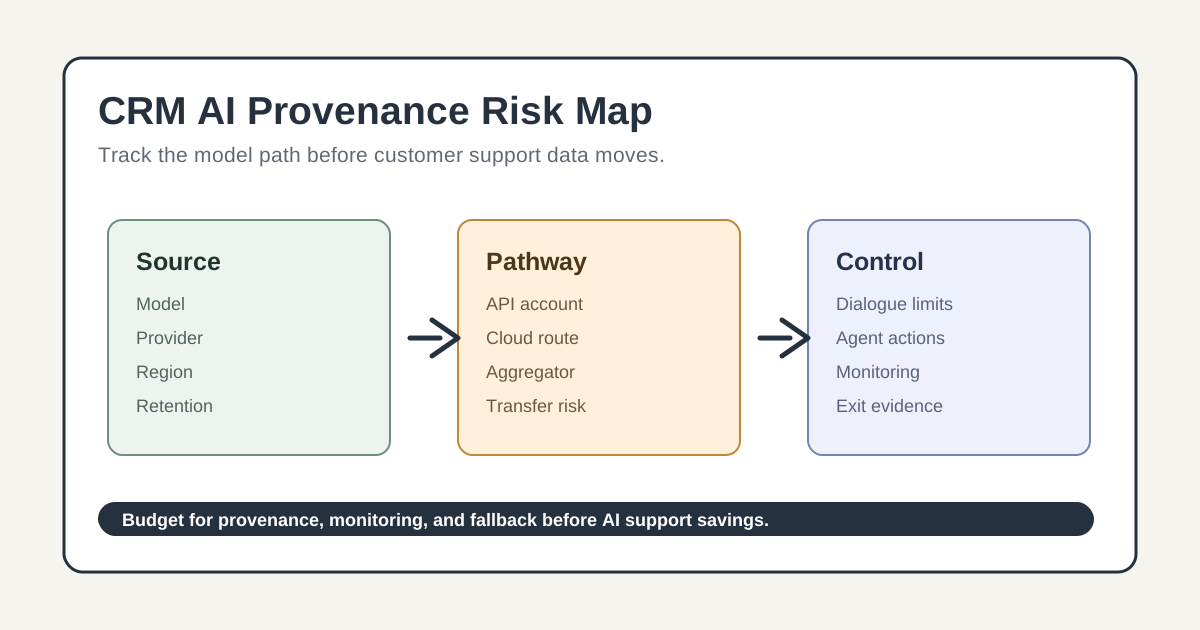
Create a model-source register with provider, region, version, subprocessor, retention setting and change notice.
Map every account and intermediary, then require contract, logging and data-use terms for each path.
Restrict sensitive fields, use approved environments, document retention settings and test redaction behavior.
Separate read, draft and action permissions; require human approval for sensitive or irreversible steps.
Assign monitoring owners, thresholds, review cadence, escalation routes and monthly evidence exports.
Keep portable prompts, workflow maps, QA samples, export rights, fallback scripts and exit acceptance tests.
What buyers should do next
Buyer FAQs
What is the CISA AI distillation warning?
A September 2026 joint cybersecurity advisory from U.S. and allied agencies warned organizations about alleged industrial-scale knowledge distillation against U.S. AI models by several China-based AI companies. AP reported that China rejected the claims and that named companies did not immediately respond.
Why does this affect CRM and support buyers?
The advisory discusses capability areas that include customer-service dialogue and agentic workflows. Those are the same classes of data and actions that CRM copilots, support bots and outsourced-agent tools may handle.
What proof should a buyer request first?
Ask for a CRM AI Provenance Risk Map covering model source, account pathway, customer-service dialogue scope, agent workflow permissions, monitoring ownership and vendor-exit evidence.