

Direct answer
Amazon Walmart AI chatbot origin claims CRM compliance cost map: what CRM buyers should take from it
Retail AI chatbot scrutiny turns product-answer compliance into a support-ops cost issue. If an AI shopping assistant tells customers where a product is made, whether a claim is substantiated, or which item matches a policy promise, the buyer needs more than a bot demo. The operation needs source data, answer parity checks, customer notice rules, human escalation, audit logs and correction proof.
Published 9/18/2026. News event: 9/18/2026.
What happened
- The Wall Street Journal reported September 18, 2026 that lawmakers asked the FTC to review whether Amazon and Walmart AI shopping chatbots gave shoppers misleading product-origin information.
- The report tied the request to research by the Columbia Center for Law and Economy that tested AI shopping assistants against country-of-origin and Made in USA-style queries.
- Columbia's July 2026 report said major ecommerce AI assistants could confidently recommend products for origin-specific prompts even when the underlying product pages did not substantiate the claim.
- FTC Made in USA guidance says marketers should support express or implied Made in USA claims with evidence and avoid conveying unqualified U.S.-origin claims unless the standard is met.
- FTC warning-letter and enforcement materials show that product-origin claims can create regulatory risk even outside an AI context, which makes chatbot answer governance a support-ops issue.
Why this is trending
- AI shopping assistants are moving product guidance from static pages into conversational answers that can sound more definitive than the underlying data.
- Customers may rely on a chatbot answer when choosing products, contacting support, disputing a purchase or asking for documentation.
- Country-of-origin and Made in USA-style claims sit at the intersection of marketing, product data, legal review, CRM notes and customer-service scripts.
- The story names large retail platforms, but the operating risk applies to any ecommerce, marketplace or support team using AI to summarize product attributes.
- Regulatory attention makes the cleanup workflow expensive: answer review, product-data fixes, customer notices, escalation rules and audit evidence all need owners.
The CRM Costs take
A CRM or helpdesk buyer should treat AI product answers as a governed support workflow. The buyer needs to know which source fields the bot can use, whether answers match the product page and approved scripts, what customers are told when the answer was wrong, who escalates regulated claims, and where the correction evidence is stored. Without that map, support teams inherit compliance cost after customers and regulators notice the mismatch.
Origin-Data Compliance Cost Map
A CRM and support-ops buyer map for budgeting AI answer source data, product-claim parity, customer notices, human escalation, audit logs and correction proof.
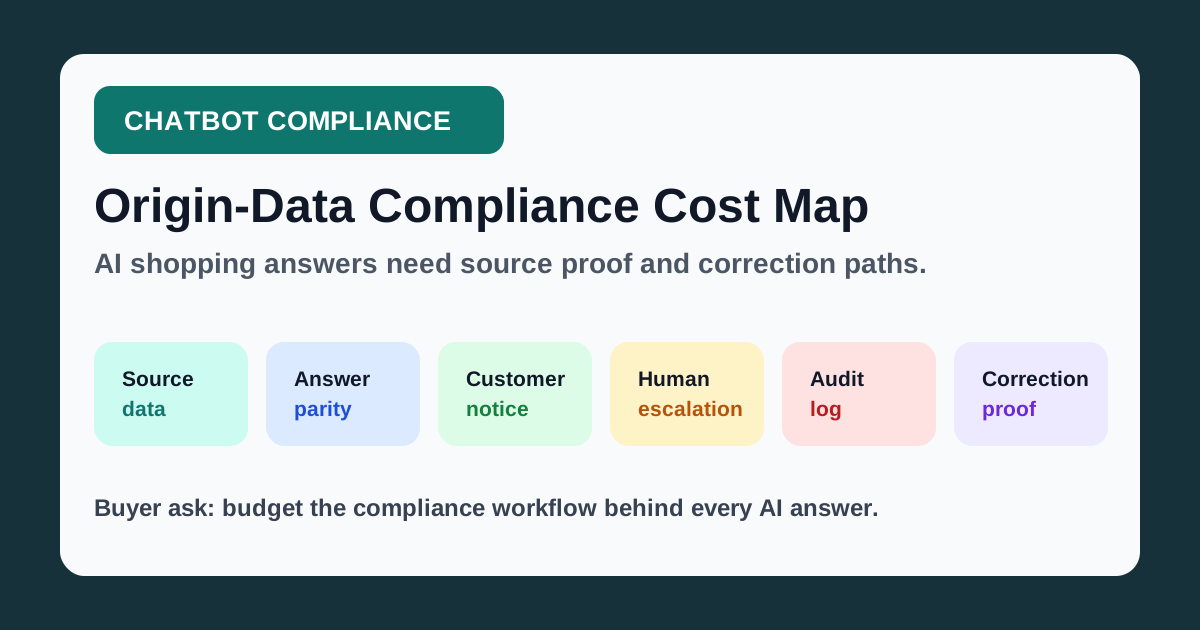
Create a source-data register with field owner, evidence standard, update cadence and restricted attributes.
Run parity tests on high-risk prompts and require the same approved claim across page, bot and support script.
Write notice criteria, refund or replacement rules, and approved language for corrected AI answers.
Block or route origin, certification, safety, finance, health and legal claims until a named owner approves them.
Keep prompt, answer, source version, reviewer, correction time and customer-impact tags in an incident record.
Close with a correction packet covering changed fields, retested prompts, updated macros, customer cases and QA samples.
What buyers should do next
Buyer FAQs
Is chatbot product-origin risk only a retail problem?
No. Any CRM, helpdesk, ecommerce or marketplace workflow that lets AI answer product, policy, warranty, safety or compliance questions needs the same source-data and correction controls.
What should buyers check before enabling AI shopping answers?
Check whether the bot can cite approved product fields, whether answers match product pages and support scripts, and whether regulated claims route to a human owner.
What is the first cost layer to budget?
Budget source-data cleanup and answer parity testing first. Without clean fields and approved language, every chatbot answer can create more support rework.