

Direct answer
AI chatbot law wave support compliance cost map: what CRM buyers should take from it
The July 2026 AI chatbot law wave means support teams can no longer evaluate chatbots only by ticket deflection. The Transparency Coalition says 14 chatbot safety measures have passed and/or been enacted in 13 states so far in 2026, and the Future of Privacy Forum says nearly 100 chatbot-specific bills are creating a fragmented compliance landscape. The federal People-First Chatbot Act would add customer-service chatbot disclosure and a right to transfer to a human operator. CRM and support buyers should require an AI Chatbot Support Compliance Cost Map before launch, renewal, or staffing cuts.
Published 7/25/2026. News event: 7/23/2026.
What happened
- The Transparency Coalition's July 24 legislative update highlighted its mid-year report on 84 AI-related laws enacted in 27 states so far in 2026.
- The same group reported that 14 chatbot safety measures have passed and/or been enacted in 13 states in 2026.
- The Transparency Coalition said the measures vary by state and expects more chatbot-related bills to pass in the next three to four months.
- The Future of Privacy Forum's 2026 Chatbot Legislation Tracker says nearly 100 chatbot-specific bills introduced across states are creating a complex and fragmented compliance landscape.
- FPF says it is tracking 98 chatbot-specific bills across 34 states plus three federal proposals.
- On July 9, 2026, Representatives Valerie Foushee and Greg Casar introduced H.R. 9619, the People-First Chatbot Act, which includes customer-service AI disclosure and a right to be transferred to a human operator upon request.
Why this is trending
- The story moved from isolated AI-safety proposals into a multi-state compliance wave that touches product design, support operations, privacy, safety, and customer service.
- Support leaders are under pressure to use chatbots for cost control, but the compliance workload can add training-data review, safety testing, disclosures, human transfer, retention, and escalation costs.
- A fragmented state-by-state environment makes a single generic chatbot policy risky for companies serving customers across jurisdictions.
- The People-First Chatbot Act adds a federal buyer signal: disclosure and human transfer are becoming expected controls, even before any one bill becomes the universal rule.
The CRM Costs take
A CRM or support buyer should use the law wave as a cost-control diligence prompt, not as a reason to freeze automation. The buyer needs an AI Chatbot Support Compliance Cost Map: which support intents use chatbots, what the customer sees, when human transfer is available, what data trains the model, which safety checks run monthly or after change, which professional-service claims are blocked, what records prove compliance, and who owns remediation if a chatbot creates harm or delay.
AI Chatbot Support Compliance Cost Map
A CRM and support-ops buyer framework for modeling chatbot compliance costs across disclosure, human transfer, data-use limits, safety assessments, professional-service boundaries, evidence retention, and enforcement exposure.
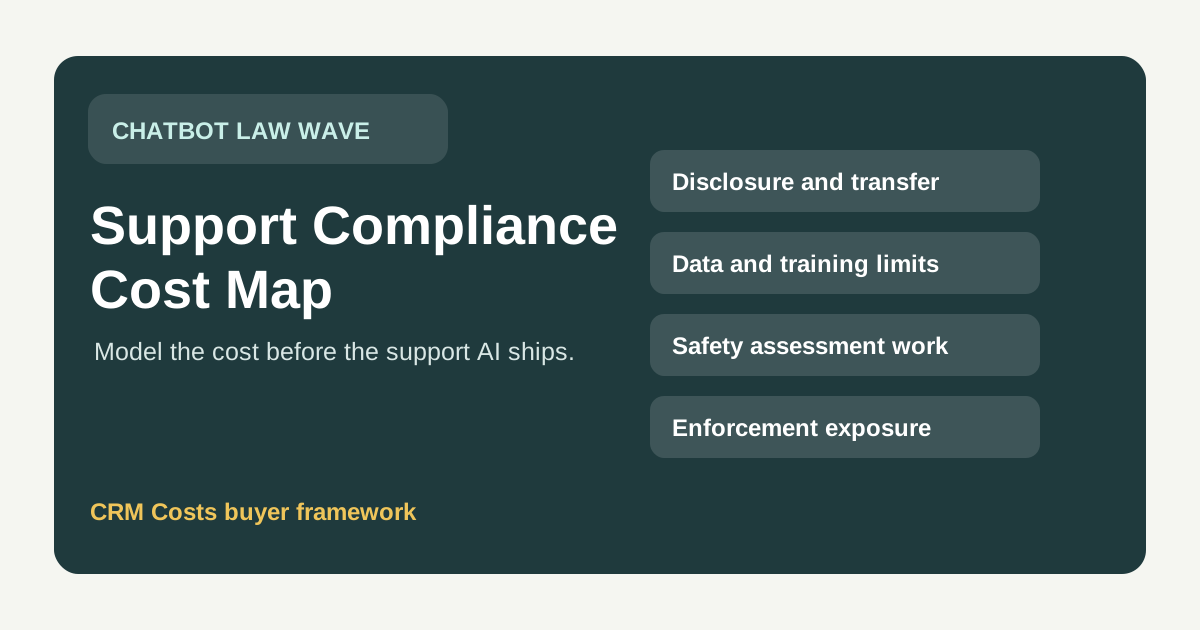
Map disclosure text, transfer buttons, phone routes, callback rules, queue ownership, and wait-time evidence by channel.
Create data-use labels, consent flags, retention rules, deletion workflows, and vendor contract terms for chatbot training data.
Schedule recurring red-team tests, scenario libraries, failure thresholds, owner signoff, and blocked-release rules.
Mark restricted topics, approved statements, escalation triggers, confidence thresholds, and human-review rules.
Build a jurisdiction and workflow matrix with active laws, proposed bills, policy owners, effective dates, and implementation status.
Retain transcripts, prompts, model versions, handoff logs, safety-review outcomes, complaint records, and remediation evidence.
What buyers should do next
Buyer FAQs
What is the 2026 AI chatbot law wave?
It is the surge of state and federal chatbot bills and laws in 2026. The Transparency Coalition says 14 chatbot safety measures have passed and/or been enacted in 13 states, while FPF tracks 98 chatbot-specific bills across 34 states plus three federal proposals.
Why does this matter to support and CRM buyers?
Chatbot ROI now depends on compliance work as well as ticket deflection. Buyers need to budget for disclosure, human transfer, data-use controls, safety testing, professional boundaries, logs, and remediation.
What proof should buyers request first?
Ask for a chatbot inventory, disclosure and human-transfer tests, data-use policy, safety assessment logs, restricted-topic rules, jurisdiction matrix, and evidence-retention plan.